

Unplugged to Recharge: Why Our Brains Need a Digital Detox
The soft blue light of the phone dances across your face at 2:37 a.m. You swipe open Instagram “just for a minute” and before you know it, it’s 3:15 a.m. By the time your head finally hits the pillow, your brain is reeling with images, comparisons, pings, a half-remembered meme. You sleep in fitful, unrefreshing chunks, waking groggy, restless, and wired.
Worldwide, this is now the standard scene. In recent surveys, 43 % of individuals report having deliberately cut back on screen time over the past six months, and more than half state they feel less anxious or stressed when disconnected. NuVoodoo For young adults, organized digital breaks have brought tangible benefits: in one intervention spanning three weeks, cutting back smartphone usage to two hours a day resulted in notable decreases in depression, sleep quality, stress, and well-being.
Why all these changes? Because our brains developed to pursue novelty, pattern, and reward, not infinite pings. Just like a muscle that exhausts from excess use, so does the neural circuitry devoted to attention, reward, and memory. When we allow devices to control us, our brain misses its opportunity to reboot.
Think about it: just as you would plan for rest days in physical training, your brain requires periods of rest from digital stimulation in order to maintain clarity, concentration, and emotional equilibrium.
In this article, we follow the neuroscience of digital overload, review the hard science on detox interventions, present real-world applications (such as Earth5R’s efforts), and provide evidence-based recommendations to assist you and your brain in unplugging and recovery
Unplugged by Choice: What a Digital Detox Really Means
In a world where our phones are never out of our hands and our screens command nearly every waking moment, the idea of digital detox is becoming increasingly timely. A digital detox is simply defined as a voluntary and temporary shutdown of digital devices smartphones, laptops, tablets, and social media sites aiming to alleviate stress, increase concentration, and restore equilibrium of the mind. Scientists have termed it voluntary avoidance of technology for a certain time to increase well-being and take back control over attention.
Consider your brain to be like a garden. Each notification, ping, and vibration is like a weed growing up and competing with the other plants for space and nutrients. If not properly weeded, the blooms of focus, calm, and creativity cannot survive. A digital detox acts as this required clearing process, enabling your mind to breathe, recharge, and thrive anew. Research shows that people who deliberately decrease screen time tend to report quantifiable advantages like enhanced sleep quality, lessened depressive symptoms, and enhanced emotional control, although outcomes can differ between different groups. (BMC Medicine)
Digital detoxes, nevertheless, are not formulaic. Others choose shorter micro-breaks, such as not using devices at mealtimes or when going to bed, which break the habitual cycle of checking and scrolling. Some try app-specific detoxes, switching off social media or entertainment sites for a week but leaving on-core communication tools intact. Most devoted users try a complete digital fast, not using any screens for 24 hours or more, a digital analogue of a mental retreat. Another sustainable strategy is gradual reduction, in which users establish bounded limits, like “no screens after 9 p.m.” or phone-free weekends.
Each strategy has its own psychological and behavioral advantages. A complete break may bring deep calm and insight, but brief, regular breaks tend to be easier to establish amidst contemporary work pressures. Ultimately, the essence of a digital detox lies not in rejection of technology, but in redefining the relationship between humans and their devices, to use technology consciously rather than compulsively. In the next section, we’ll explore what constant connectivity actually does to the brain, and why even brief digital rest periods are essential for cognitive health and emotional resilience.
How Digital Life Redefines the Brain — A Neuroscience Primer
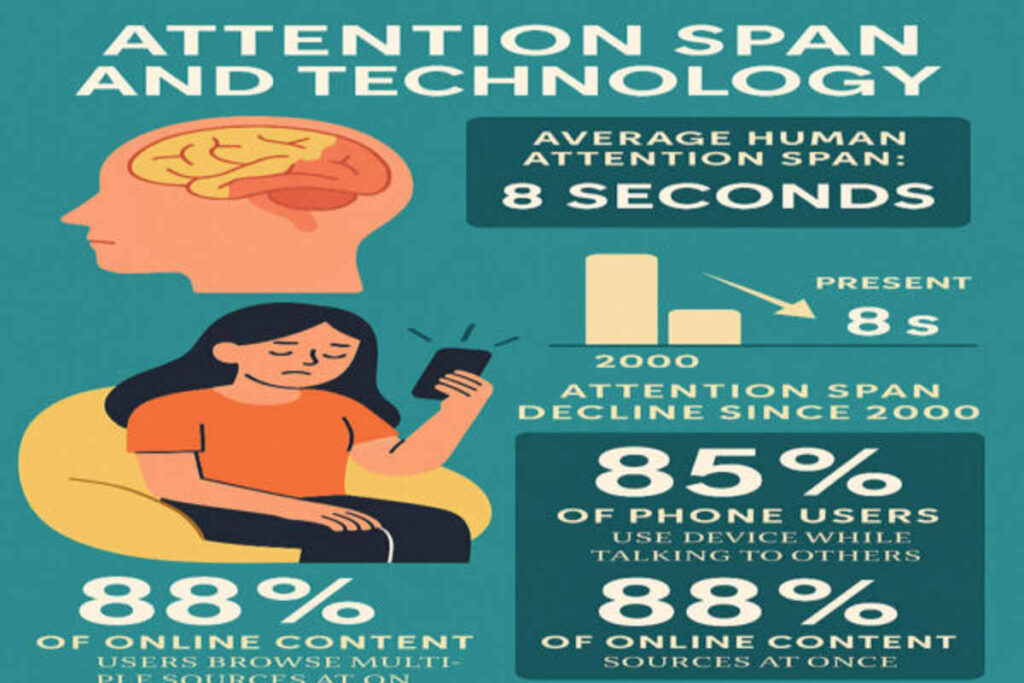
With our always-connected culture, our brains are being rewired—not only socially, but biologically. Every ping, every scroll, and every feed curated by algorithms pressed on neural circuits that developed decades, even centuries, before there were smartphones. Knowing how this pressure functions is central to understanding why a digital detox is not an indulgence but a requirement.
At the center of the shift is the brain’s reward system, or mesolimbic pathway. This loop connecting the ventral tegmental area and the nucleus accumbens is evolution’s blueprint for strengthening survival behaviors, such as eating or social attachment, by releasing dopamine when we gain a reward.
But social media feeds, notifications, and never-ending content replicate that reward loop in artificially exaggerated form. Clicking “like,” viewing updates, or reloading a feed each trigger a micro-dopamine fix sometimes erratically, akin to a slot machine.
Repeatedly, these micro-rewards can desensitize the system, requiring increasingly more stimulation to produce the same “reward” , the signature feature of behavioral addiction.
Concurrent with this, our attentional circuits are under attack. Contemporary digital media are often rapid, discontinuous, and superficial, challenging the brain to hop between stimuli. In one review published recently, scientists discovered that excessive social media consumption is associated with reduced sustained attentional capacities, possibly because they become accustomed to fast, multimodal switching.
Neuroscientific theories posit that extended multitasking and interruption suppress executive control the ability of the brain to block distractions and structure thinking by overloading the prefrontal cortex.
In adolescents and children, whose brains are under development, the danger is more significant. Various MRI and diffusion tensor imaging (DTI) studies cite correlations between excessive screen usage and changed white-matter tracts in frontal and associative areas associated with impulse management, emotional regulation, and cognitive integration.
Some results are similar to attention-deficit/hyperactivity disorder (ADHD), with “inattention” characteristics more frequent in heavy screen users.
Sleep and the circadian rhythms provide another avenue of harm. Screens, particularly in the evening, release blue light that inhibits melatonin, moving our internal clocks later.
The consequence: briefer, more disrupted sleep, which cascades into memory consolidation impairments and emotional weakening.
The muscle overload metaphor is well-chosen: put a muscle under continuous microstrain with no rest, and it becomes weakened, less responsive, and injury-prone. So too with the brain’s circuits reward, attention, control, regulation. They need downtime. Absent it, risk is not only mental exhaustion but ongoing rewiring to distraction, superficial reward seeking, and emotional instability.
In the next section, we’ll examine empirical findings, intervention trials and longitudinal data that quantify just how much damage (and recovery) a digital detox can deliver.
The Advantages of a Digital Detox : What the Research Shows
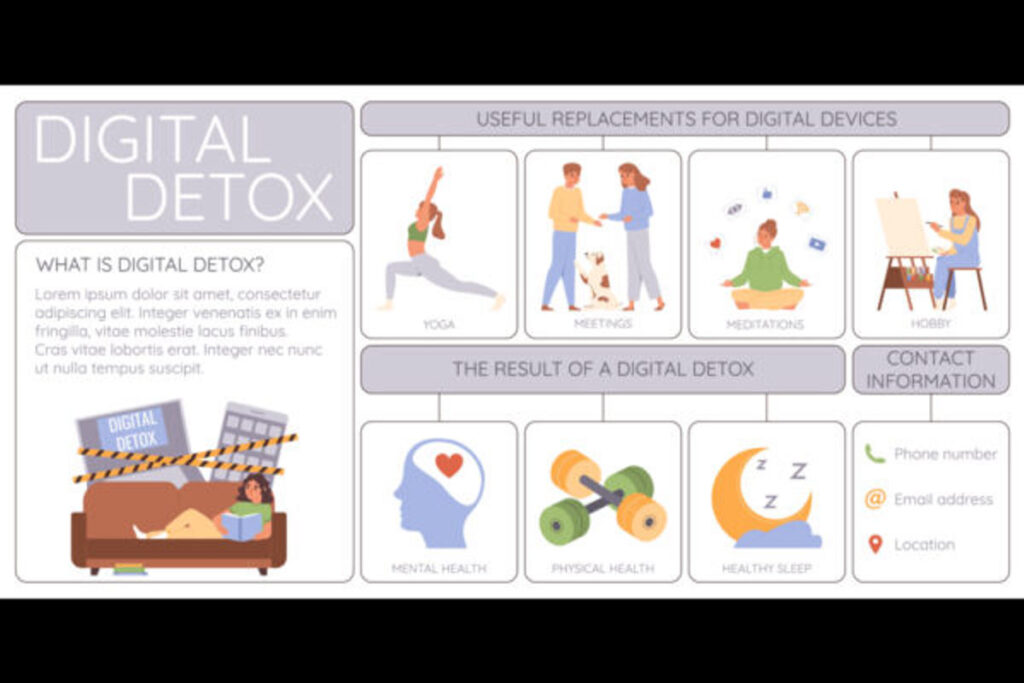
When the constant stream of notifications is quieted, the brain does something amazing: it starts to recover. The last couple of years of behavioral and neuroscientific evidence have begun to measure what numerous individuals naturally sense—that distancing oneself from screens, even for a short time, re-establishes mental clarity, enhances mood, and readjusts focus. Experimental research now lends empirical merit to what was previously anecdotal.
In a 2024 randomized controlled trial in BMC Medicine, those whose smartphone use was cut down to only two hours per day for three weeks experienced improved sleep quality, mood, and perceived levels of stress, as well as the pronounced reduction of symptoms of smartphone addiction. These changes reflect results of previous interventions where abstention from social media enhanced life satisfaction and reduced anxiety. Freed from the loops of constant reward-seeking, the brain starts to return to its natural balance of attention and rest similar to how muscles recover from overuse.
The sleep advantages are especially strong. By reducing late-night blue light and emotional arousal from scrolling, detox participants had quicker onsets of sleep and longer REM segments critical ingredients in memory consolidation and emotional management (Sleep Foundation). Most participants felt “mentally lighter” and more alert during the day, a subjective measure of the brain’s enhanced restorative function.
Psychologically, the benefits reach beyond sleep. A number of surveys and meta-analyses, such as those in Computers in Human Behavior, demonstrate that cutting down screen time is linked with increased mindfulness, improved emotional control, and increased self-esteem. Essentially, a digital detox opens the door to what psychologists term “meta-awareness” : the ability to observe one’s thoughts without being overwhelmed by them.
And perhaps the most compelling evidence is the rate of recovery. Unlike other behavioral therapies that require months, cognitive and emotional change from digital reduction can be observed in days. The implication is clear: just as the body needs balance between activity and rest, so the brain relies on moments of digital quiet to function at its finest.
As one scholar at the University of Potsdam so succinctly phrased it, “Detoxing from digital noise isn’t about disconnection it’s about reconnection: with sleep, with presence, and with ourselves.”
Case Studies in Action: Earth5R and Behavioral Detox Trials
Earth5R: Turning Digital Time into Real-World Action
Theory comes alive in practice, and in the context of digital detox, few examples illustrate this better than Earth5R, a global sustainability platform that transforms technology into a catalyst for offline engagement. Although not a detox app in the traditional sense, Earth5R demonstrates how digital tools can be designed to encourage real-world action rather than passive consumption.
Through its Earth5R App, users record tangible environmental contributions such as tree planting, community clean-ups, and neighborhood e-waste audits using geotagged photos and reports. Because every action is verified and rewarded with measurable impact points, participants effectively exchange screen time for “doing time.” This redefines the purpose of digital interaction: the screen becomes not a distraction but a bridge to meaningful, offline impact .
One of Earth5R’s community pilots illustrates this transformation beautifully. The organization embedded QR codes on public waste bins, allowing citizens to log responsible disposal acts simply by scanning. The outcome was twofold: a spike in correct waste behavior and the generation of valuable geospatial data for city planners. The initiative embodies a crucial principle digital time does not have to be wasted time; it can be redirected toward civic engagement and environmental restoration.

Behavioral Detox Trials: The Science of Rapid Recovery
In parallel with civic innovation, behavioral science provides robust evidence for the benefits of structured digital withdrawal. In a landmark two-week social media abstinence trial, researchers asked volunteers to restrict their social media use. The results were striking. Participants reported better sleep quality, lower stress, and higher life satisfaction within days of beginning their detox .
The speed of change was particularly noteworthy. Cognitive and emotional recovery occurred within a short timeframe, suggesting that the adverse neural and psychological effects of digital overload are not fixed but reversible. As one neuroscientist noted, “When external stimuli are reduced, the brain doesn’t merely rest, it recalibrates.”
These studies reaffirm that the human brain is remarkably plastic, capable of regaining focus, calm, and control when given even modest intervals of digital silence.
The Shared Lesson: Redirection, Not Rejection
Together, the Earth5R model and behavioral detox research converge on a powerful insight: digital detox is not simply about disconnection, but about reconnection to nature, to community, and to one’s inner balance. The message is not to abandon technology, but to reimagine its purpose. Whether logging an act of sustainability or unplugging for a mindful pause, the goal remains the same: to reclaim agency in how we use our most precious resource attention.
Reclaiming Focus: Practical, Evidence-Based Digital Detox Plans

While the science of digital overload is increasingly clear, the solution does not demand a monastic retreat it begins with structured, evidence-based routines. A digital detox plan, when designed around behavioral psychology and sleep research, can be both sustainable and restorative. The key, experts note, is substitution, not deprivation: replacing passive screen habits with active, meaningful engagement that satisfies the same emotional needs for novelty, connection, or purpose.
For beginners, even a one-day digital reset can have measurable benefits. Studies from the University of Bath and BMC Psychology show that 24 hours without social media significantly improves mood and reduces cortisol, the body’s stress hormone. During this short reset, individuals are encouraged to schedule analog activities that activate similar reward pathways like walking outdoors, journaling, or meeting friends in person. Neuroscientists describe this as “retraining the reward system,” helping the brain rediscover satisfaction in slower, sensory-rich experiences.
A seven-day detox deepens this process. Cognitive-behavioral therapists suggest establishing “tech-free zones” in spaces associated with rest, such as the bedroom or dining table, to condition the brain for boundaries. Sleep studies published in JAMA Network Open highlight that removing screens 60 to 90 minutes before bedtime can improve sleep efficiency by up to 30%, reinforcing natural circadian rhythms . This weeklong plan isn’t just about avoidance; it’s a rehearsal for long-term balance.
For sustained transformation, a 30-day digital moderation plan focuses on consistency. Users gradually reduce screen exposure by 10–15% per week while tracking screen time, sleep hours, and emotional well-being through reflective journaling. Many participants also replace online time with civic or environmental initiatives, such as contributing to projects on the Earth5R App, linking digital detox with real-world purpose.
Behavioral researchers emphasize that these structured routines leverage habit substitution and neuroplastic recovery. By consciously redesigning how we engage with technology, even brief detox phases can reset attention spans, recalibrate dopamine balance, and restore mental clarity proving that small, consistent steps can reclaim focus in a world that rarely pauses.
FAQs on Digital Detox: Why Your Brain Needs It
What exactly is a digital detox?
A digital detox is a deliberate and temporary break from digital devices such as smartphones, laptops, and social media platforms. It helps reduce stress, restore focus, and bring emotional clarity by consciously limiting technological engagement in daily life.
Why does the brain need a digital detox?
The brain’s reward and attention circuits are constantly overstimulated by notifications, updates, and endless scrolling. Taking a break allows these neural systems to reset, improving concentration, memory retention, and emotional stability.
How long should a digital detox last?
There is no universal rule. Some individuals experience results after a 24-hour detox, while others adopt week-long or month-long routines. The key is sustainability consistent small breaks often yield better results than occasional extremes.
Is there scientific evidence supporting digital detox benefits?
Yes. Multiple studies, including those in BMC Medicine and Computers in Human Behavior, confirm that reducing screen exposure enhances sleep quality, lowers anxiety, and boosts overall well-being.
Can a digital detox be done without affecting work commitments?
Yes. Many people follow partial detox routines limiting personal social media or entertainment use while keeping essential work communication active. This balance maintains productivity while reducing mental fatigue.
How does excessive screen time affect attention span?
Continuous digital stimulation shortens attention spans. The brain becomes conditioned to expect rapid information and struggles with sustained focus on deeper or slower tasks.
What are the sleep benefits of reducing screen time?
Reducing screen exposure before bed allows melatonin the sleep hormone to regulate naturally. People who adopt screen-free nights report faster sleep onset, deeper sleep cycles, and improved morning energy levels.
Does a digital detox help reduce anxiety or depression?
Research shows that stepping away from social media can decrease stress and symptoms of mild depression, especially among those prone to excessive scrolling or social comparison.
How can digital detox improve relationships?
Disconnecting from screens during interactions enhances empathy and attention. When people engage fully in conversations, they communicate more deeply and experience stronger emotional connection.
What role does dopamine play in digital addiction?
Digital platforms trigger dopamine releases the same neurotransmitter linked with reward and pleasure. Over time, this reinforcement loop leads to compulsive checking. Detoxing breaks the pattern and helps restore balance.
Is digital detox effective for children and teenagers?
Yes. Research using brain imaging has linked heavy screen use in children to differences in white-matter development and self-regulation. Parental guidance and limited screen windows support healthier growth.
What is the connection between digital detox and productivity?
Digital breaks restore executive function, improving creativity, decision-making, and problem-solving. Fewer interruptions mean deeper work and more efficient outcomes.
Can apps actually support a digital detox?
Yes. Apps like the Earth5R App use technology constructively by encouraging users to log environmental actions and volunteer work, promoting real-world engagement instead of passive screen use.
What are the best first steps toward a digital detox?
Simple practices like turning off push notifications, avoiding screens during meals, and setting daily tech-free hours can ease the transition into healthier habits without feeling restrictive.
Is total disconnection from technology realistic today?
Total abstinence is rarely practical, but intentional use is. The goal of a digital detox is not rejection of technology but rebalancing using it mindfully and purposefully.
How quickly can benefits from a digital detox appear?
Improvements in mood and sleep are often noticeable within three days of reduced use, while greater gains in focus and mental clarity typically appear after one or two weeks.
Can a digital detox enhance creativity?
Absolutely. Without constant digital noise, the brain enters reflective states conducive to creative thinking and insight. Many writers and innovators credit digital breaks for their breakthroughs.
What challenges do people face during a digital detox?
Initially, users may feel restless, bored, or anxious a phenomenon known as “digital withdrawal.” These sensations usually fade as the brain adjusts to a calmer rhythm of engagement.
How can organizations promote digital well-being among employees?
Workplaces can encourage offline time by instituting “no-email hours,” promoting phone-free meetings, and creating awareness about the cognitive strain of multitasking.
Is digital detox a temporary fix or a lifelong practice?
It can be both. Short detoxes offer quick relief from overload, but lasting results depend on cultivating digital mindfulness—a conscious, balanced approach to technology use.
Unplug to Reconnect: The Real Power of a Digital Detox
In an age defined by perpetual connection, the true act of resistance may be learning to pause. A digital detox is not a rejection of technology it is a recalibration of our relationship with it. Neuroscience now affirms what intuition long whispered: the brain, like any complex system, requires rest to regenerate focus, creativity, and emotional balance. Just as the body needs intervals between workouts, the mind thrives on moments of digital stillness.
The evidence from BMC Medicine Study is unequivocal short breaks from constant connectivity can improve sleep, boost mood, and sharpen attention. But beyond the science lies something deeper: a chance to re-engage with life beyond the screen. Whether it’s joining a local cleanup through the Earth5R App, sharing a meal without devices, or simply watching the sunset uninterrupted, each unplugged moment strengthens the neural and emotional circuits of presence.
The next notification can wait. What cannot wait is your attention the rarest and most valuable resource of the digital age. So start small. Try one day, or even one hour, of conscious disconnection. Let silence replace scrolling, and see how quickly the mind remembers what peace feels like.
Authored by- Sneha Reji


