

The Modern Sleep Crisis: Unlocking the Science of Deep Rest
The modern world is in the midst of a silent epidemic, one that unfolds every night in bedrooms across the globe. According to the Centers for Disease Control and Prevention (CDC), more than a third of adults are not getting enough sleep on a regular basis. This isn’t just a matter of feeling tired; it is a full-blown public health crisis linked to a host of chronic diseases and cognitive impairments.
Our predicament is a classic case of an evolutionary mismatch. Our bodies and brains are running on ancient biological software, fine-tuned over millennia to the natural rhythms of light and dark. Yet, we are asking them to operate in a world of artificial light, constant digital stimulation, and relentless productivity demands. We are essentially living with Stone Age brains in a digital world, and our sleep is paying the price.
The constant glow from our screens and the expectation of 24/7 availability directly sabotage our delicate internal clocks. This has created a profound disconnect between our lifestyle and our physiology. To fix this, we need to do more than simply try harder to sleep; we must understand the very nature of the rest we are trying to achieve.
To reclaim our nights, we must first understand what we’re aiming for. True restorative sleep is not a simple “off” switch for the brain. It is an intricate and dynamic journey through different architectural stages, two of which are absolutely critical for our health and well-being. These are the pillars of what we call “deep rest.”
The first of these is Slow-Wave Sleep (SWS), often called deep sleep. This is the body’s prime time for physical restoration, when growth hormone is released to repair tissues, the immune system is fortified, and metabolic waste, including proteins linked to Alzheimer’s disease, is cleared from the brain. Think of SWS as the body’s expert overnight maintenance crew, diligently working to fix, clean, and prepare you for the next day. More information on these stages can be found at the Sleep Foundation.
The second pillar of quality rest is REM (Rapid Eye Movement) sleep. If SWS is for the body, REM sleep is a form of overnight therapy for the mind. It is during this dreaming stage that our brain processes emotions, cements complex motor skills, and fosters creativity by forming novel connections between ideas. It is essential for mental resilience and our ability to navigate complex social and emotional landscapes.
This article moves beyond vague advice like ‘get more sleep.’ Instead, we will delve into the science behind 10 specific, evidence-based habits designed to systematically enhance both Slow-Wave and REM sleep. By understanding and implementing these strategies, you can learn to work with your biology, not against it, to unlock the profound, restorative power of a truly deep night’s rest.
The Twin Engines of Sleep: How Your Body Knows When to Rest
To master sleep, we must first appreciate that it is not a passive state but a precisely regulated biological function. Far from being random, your desire for sleep is controlled by two distinct yet interconnected systems working in constant harmony. This concept is known to sleep scientists as the two-process model of sleep regulation, and understanding it is the key to unlocking better rest.
The first of these systems is your Circadian Rhythm, which acts as the body’s master clock. Tucked deep inside your brain’s hypothalamus is a tiny cluster of about 20,000 neurons called the Suprachiasmatic Nucleus (SCN). Think of the SCN as the conductor of a grand biological orchestra, ensuring countless bodily processes, from hormone release to body temperature, follow a predictable 24-hour cycle.
This internal clock’s most important job is managing the release of two key hormones. As darkness falls, the SCN signals the pineal gland to release melatonin, the “hormone of darkness,” which tells your body it is time to wind down. Conversely, when morning arrives, the clock triggers a surge in cortisol, an alertness hormone that helps you wake up and feel ready for the day. This delicate hormonal dance is the foundation of your natural sleep-wake cycle.
The second engine driving your sleep is known as Sleep Pressure. Imagine this system as a biological hourglass. From the moment you wake up, a neuromodulator called adenosine begins to accumulate in your brain. With each passing hour of wakefulness, more and more adenosine builds up, steadily increasing the “pressure” or desire to sleep.
This process is why you feel sleepier the longer you have been awake. The intense feeling of drowsiness after a long day is the direct result of high adenosine levels signaling to your brain that it is time to rest. During deep, slow-wave sleep, the brain actively clears this adenosine away, resetting the hourglass so you can wake up feeling refreshed and alert the next morning.
The very best sleep occurs when these two systems are perfectly aligned. You want your circadian drive for sleep (high melatonin) to peak just as your sleep pressure (high adenosine) reaches its maximum. When the master clock says it’s time for bed and the hourglass is full, sleep becomes effortless and deep. The following 10 habits are powerful, science-backed strategies designed to synchronize these two engines, ensuring they work together to deliver truly restorative rest.
The 10 Evidence-Based Habits for Deep Rest
Understanding the core principles of sleep is the first step, but putting that knowledge into practice is what transforms your nights. The following 10 habits are not merely suggestions; they are strategic interventions designed to directly support your circadian rhythm and manage your sleep pressure. By integrating them into your routine, you can systematically engineer a better night’s sleep.
Theme 1: Calibrating Your Master Clock
1. Anchor Your Day with a Consistent Wake-Up Time.
Your brain’s master clock, the SCN, thrives on predictability. Waking up at the same time every day, including weekends, is the single most effective way to reinforce your circadian rhythm. This consistency sets a stable 24-hour cycle for your body’s hormonal and metabolic processes.
When you sleep in late on weekends, you induce a condition researchers call social jetlag. This desynchronizes your internal clock from the external world, leading to that familiar Monday morning grogginess. Think of it like flying to a different time zone and back every single weekend. Consistency is the anchor for your circadian rhythm, telling your body precisely when to be alert and when to feel sleepy.
2. Seek Morning Light, Avoid Evening Light.
Light is the most powerful signal controlling your sleep-wake cycle. Getting direct sunlight exposure for 10-15 minutes within the first hour of waking is like pressing the “start” button on your internal clock. This powerful dose of morning light suppresses melatonin production and triggers a healthy cortisol peak, locking in your rhythm for the day.
Conversely, evening light, particularly the blue light emitted from screens, is profoundly disruptive. Research from Harvard Medical School shows that this light fools the brain into thinking it is still daytime, delaying the crucial release of melatonin. Dimming the lights and avoiding screens for 60-90 minutes before bed is a non-negotiable step to allow your “hormone of darkness” to rise naturally.
Theme 2: Engineering Your Sleep Sanctuary
3. Drop Your Core Body Temperature.
To initiate and maintain deep sleep, your body’s core temperature needs to drop by about 1 to 2 degrees Celsius (2-3°F). A cool environment facilitates this natural process. Sleep scientists, including those at the National Sleep Foundation, have found that the optimal room temperature for sleep is surprisingly cool, around 18.3°C (65°F).
You can amplify this effect by taking a warm bath or shower about 90 minutes before bed. This might seem counterintuitive, but the warm water draws blood to the surface of your skin. When you get out, the rapid cooling of your body sends a powerful signal to your brain that it is time for bed.
4. Achieve True Darkness and Silence.
Our modern bedrooms are often filled with light and sound pollution that can sabotage sleep quality. Even low levels of light from a phone charger or a streetlamp can penetrate your eyelids and inhibit melatonin production, preventing you from reaching the deepest stages of sleep.
Similarly, unexpected noises can cause “micro-arousals.” These brief disturbances pull your brain out of deep or REM sleep, often without you ever consciously waking up. The result is fragmented sleep that leaves you feeling unrefreshed. Using blackout curtains, an eye mask, and earplugs or a white noise machine can create the sensory void necessary for uninterrupted rest.
Theme 3: Mindful Consumption
5. Taper Your Caffeine and Alcohol Intake.
Caffeine is highly effective at promoting wakefulness because it works as an adenosine antagonist. It blocks the adenosine receptors in your brain, effectively muting the “sleep pressure” signal. Due to its long half-life, a significant portion of the caffeine from an afternoon coffee can still be circulating in your system at bedtime, reducing your deep slow-wave sleep. A general rule is to avoid caffeine at least 8-10 hours before bed.
Alcohol, while a sedative, is a major sleep disruptor. It may help you fall asleep faster, but as your body metabolizes it, a “rebound effect” occurs. This causes awakenings in the second half of the night and, as confirmed by numerous studies, severely suppresses REM sleep, which is critical for emotional and mental restoration.
6. Finish Eating 3 Hours Before Bed.
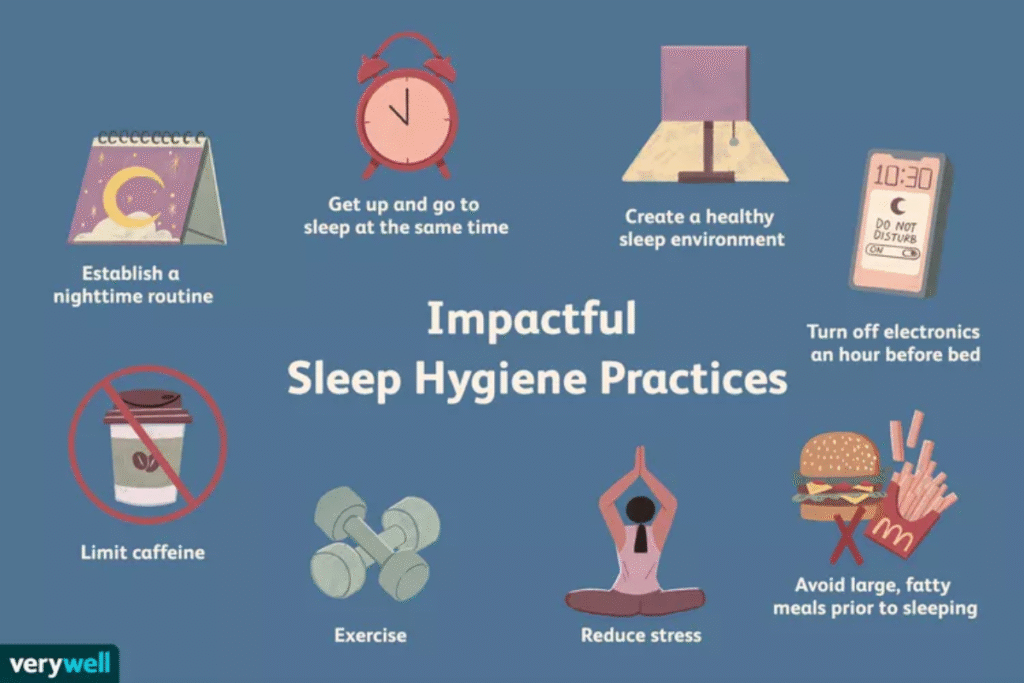
Digestion is an active, energy-intensive process. A large meal close to bedtime can raise your core body temperature and increase your heart rate, both of which are counterproductive to falling asleep. It can also lead to issues like acid reflux when you lie down.
Giving your body a buffer of at least three hours between your last meal and bedtime allows your digestive system to do its work and your body to begin its cooling-down process uninhibited. This simple habit aligns your metabolic state with your sleep-readiness state.
Theme 4: Preparing Mind and Body for Rest
7. Exercise Daily, But Not Too Late.
Regular physical activity is one of the best ways to improve sleep quality. Exercise increases the amount of time you spend in slow-wave sleep, the most physically restorative stage. It helps reduce stress and anxiety, and the rise in body temperature during your workout allows for a more pronounced and sleep-inducing drop later in the evening.
The timing, however, is crucial. Intense exercise within 2-3 hours of bed can be over-stimulating, raising cortisol and heart rate to levels that interfere with sleep onset. Aim for daily movement, but schedule your more vigorous workouts for the morning or afternoon.
8. Create a “Wind-Down” Buffer Zone.
You cannot expect your brain to switch from a high-alert, productive state directly into a state of rest. A wind-down routine is essential for facilitating the transition from your sympathetic nervous system (“fight-or-flight”) to your parasympathetic nervous system (“rest-and-digest”).
This 30-to-60-minute buffer zone should be screen-free and relaxing. Activities like reading a physical book, listening to calm music, gentle stretching, or meditation signal to your brain and body that the day is over. This mental “landing strip” is crucial for a smooth descent into sleep.
9. Perform a “Brain Dump” to Tame a Racing Mind.
One of the most common barriers to sleep is cognitive hyperarousal, or a racing mind. Research from Baylor University has provided a simple solution. The study found that individuals who spent five minutes writing a to-do list for the next day fell asleep significantly faster than those who did not.
This act of “offloading” your worries and plans onto paper externalizes them, freeing up mental space and preventing you from ruminating on them in bed. This simple journaling practice can be a powerful tool to quiet an anxious mind.
10. Protect Your Bed: For Sleep Only.
Your brain is a powerful association machine. Through a process of classical conditioning, it learns to associate specific environments with specific activities. If you regularly work, watch TV, or worry in your bed, your brain will begin to associate the bed with wakeful, stressful activities.
This is a core principle of Cognitive Behavioral Therapy for Insomnia (CBT-I), the gold-standard treatment for insomnia. To build a powerful sleep association, your bed should be for sleep and intimacy only. If you find yourself unable to fall asleep after 20-25 minutes, get out of bed, do a relaxing activity in low light, and only return when you feel sleepy again.
Putting the Science into Practice: Case Studies in Sleep Transformation
These scientific principles and habits are not just theoretical concepts, they are practical tools that create profound, real-world change. To illustrate their power, let’s examine how implementing just a few targeted strategies can resolve common and frustrating sleep problems. The following case studies showcase the transformative impact of aligning one’s lifestyle with their biology.
Case Study 1: The Executive with “Social Jetlag”
Anjali, a 42-year-old tech executive in Bengaluru, was caught in a classic modern work cycle. Her demanding job meant late nights during the week, which she tried to “compensate” for by sleeping in until 11 a.m. or later on weekends. Despite getting more hours of sleep, she consistently felt groggy, unfocused, and irritable every Monday, a feeling that lingered for days.
She was experiencing a textbook case of social jetlag, where the body’s internal clock is constantly being shifted back and forth. Following the science, she implemented two key habits: a consistent wake-up time (Habit 1) and immediate morning light exposure (Habit 2). She set an alarm for 7:30 a.m. every single day, including Saturday and Sunday, and spent the first 15 minutes of her morning on her balcony with a cup of tea, soaking in the sunlight.
This simple consistency provided a powerful anchor for her circadian rhythm. As detailed by the National Institute of General Medical Sciences, a regular wake-up time and morning light are the strongest signals to synchronize the master clock. Within three weeks, Anjali’s Monday morning fog lifted, her energy levels stabilized throughout the week, and she no longer felt like she was fighting a losing battle against fatigue.
Case Study 2: The Student with Evening Anxiety
Rohan, a 21-year-old university student in Delhi, faced a different challenge: a racing mind. As soon as his head hit the pillow, his brain would flood with worries about exams, assignments, and the next day’s schedule. He would often lie awake for over an hour, scrolling on his phone in a futile attempt to distract himself, which only made things worse.
His issue was a clear case of cognitive hyperarousal. He decided to tackle this by creating a mental buffer zone before bed. He adopted a strict “wind-down” routine (Habit 8) and started a “brain dump” journal (Habit 9). For the last hour of his evening, he put his phone away. He spent ten minutes writing down every single task and worry, effectively offloading them onto paper. He then spent the next 30 minutes reading a novel.
This two-pronged approach worked wonders. The journaling practice is a form of cognitive offloading, a technique shown to reduce the mental burden that can delay sleep. The screen-free reading period helped his nervous system shift from a state of stress to one of rest. His sleep latency, or the time it took to fall asleep, dropped from nearly 90 minutes to less than 20. He felt a renewed sense of control over his nights and less anxiety about the prospect of going to bed.
Conclusion: Sleep is Not a Luxury, It’s Your Biology
The ten habits detailed in this article are far more than a simple checklist. They represent an integrated system for biological alignment. Each practice is a deliberate tool designed to fine-tune the two core engines of your rest: the steady 24-hour cycle of your Circadian Rhythm and the gentle, rising tide of your Sleep Pressure. When these systems are synchronized, deep sleep ceases to be a struggle and becomes an effortless nightly event.
For too long, we have treated sleep as a disposable luxury, the first thing to be sacrificed in the pursuit of productivity or leisure. Modern science, however, has unequivocally shown this to be a grave mistake. Sleep is not passive downtime, it is an intensely active and critical period of restoration for both the mind and body. The World Health Organization recognizes sleep as a fundamental pillar of health, as essential as nutrition and exercise.

Viewing sleep as a nightly chore is a flawed perspective. Instead, think of it as the most potent form of self-improvement available to you. It is a nightly reset for your brain, a deep clean for your body’s cells, and the foundation upon which your mood, focus, and physical vitality are built each day. It is a non-negotiable biological necessity for a thriving life.
The journey to better sleep does not require a complete life overhaul overnight. The most effective approach is to start small. Choose just one or two of these habits that feel most achievable to you, perhaps getting morning sunlight or creating a screen-free wind-down zone. By taking control of your nights, even in these small ways, you empower yourself to fundamentally transform your days.
Frequently Asked Questions : Sleeping Habits
Why is a consistent wake-up time more important than a consistent bedtime?
A consistent wake-up time is the most powerful anchor for your body’s 24-hour internal clock, or circadian rhythm. It sets a predictable start to your day, which in turn regulates the timing of hormone release, like cortisol in the morning and melatonin at night. While a consistent bedtime is also beneficial, the wake-up time is the primary signal that locks your entire sleep-wake cycle into a stable rhythm.
Is it really necessary to avoid screens for a full hour before bed?
Yes, for optimal results. The blue light emitted by phones, tablets, and computers is particularly effective at suppressing the release of melatonin, the hormone that signals your brain it’s time to sleep. Avoiding screens for 60-90 minutes creates a crucial “buffer zone” that allows melatonin to rise naturally, making it much easier to fall asleep and achieve deeper rest.
I feel like alcohol helps me fall asleep. Why is it considered bad for sleep?
Alcohol is a sedative, so it can indeed make you feel sleepy and reduce the time it takes to fall asleep. However, this initial effect is deceptive. As your body metabolizes the alcohol, it causes a “rebound effect” in the second half of the night. This leads to fragmented sleep, frequent awakenings, and severe suppression of REM sleep, which is vital for mental and emotional restoration. You may fall asleep faster, but the quality of your sleep is significantly compromised.
What should I do if I wake up in the middle of the night and can’t get back to sleep?
The most important rule is to not stay in bed tossing and turning for more than 20-25 minutes. This prevents your brain from associating your bed with the stressful feeling of being awake. Instead, get out of bed, go to another room, and do a relaxing, low-light activity like reading a physical book or meditating. Only return to bed when you feel sleepy again.
Can I “catch up” on lost sleep during the weekend?
While sleeping in on the weekend can help repay some of the adenosine “sleep debt” you’ve accumulated, it’s not a perfect solution. You cannot fully recover all the lost benefits of deep and REM sleep. Furthermore, sleeping in disrupts your circadian rhythm, creating “social jetlag” that can make it much harder to wake up on Monday morning. Consistency is always the better long-term strategy.
How long does it take for these new sleep habits to start working?
The effects of some habits, like creating a cool, dark room, can be felt almost immediately. Others that involve resetting your circadian rhythm, such as maintaining a consistent wake-up time, may take one to two weeks before you notice a significant and stable improvement in your energy levels and sleep quality. Consistency is key.
Are naps good or bad for sleep?
Naps can be beneficial if done correctly. A short nap of 20-30 minutes in the early afternoon can improve alertness without significantly impacting your nighttime sleep. However, long naps or naps taken late in the day can reduce the adenosine “sleep pressure” that has built up, making it much more difficult to fall asleep at night.
Why does my room need to be so cool? I feel more comfortable when it’s warm.
Your body’s core temperature must drop by 1-2 degrees Celsius to initiate and maintain sleep. A cool room, ideally around 18.3°C (65°F), facilitates this natural biological process. A room that is too warm can interfere with this temperature drop, leading to more fragmented sleep and less time spent in restorative deep sleep.
Is caffeine in the afternoon really that bad?
Yes, for most people. Caffeine has a long half-life, meaning it stays in your system for many hours. A cup of coffee at 3 p.m. can still have a significant portion of its caffeine active in your brain at 10 p.m. It works by blocking adenosine receptors, which masks feelings of sleepiness and can rob you of deep, slow-wave sleep, even if you manage to fall asleep.
What if my schedule prevents me from getting morning sunlight?
If you cannot get outside, try to spend at least 15-20 minutes near a bright window. While not as powerful as direct sunlight, it is still a potent signal to your brain’s master clock. On very dark days or for those with challenging schedules, a light therapy lamp that simulates sunlight can also be an effective tool to anchor your circadian rhythm.
Should I use a sleep-tracking app or device?
Sleep trackers can be useful for monitoring your sleep patterns and identifying how certain habits (like late-night meals or alcohol) affect your rest. However, they are not always 100% accurate in distinguishing sleep stages. They are best used as a motivational tool to encourage consistency, but try not to become overly anxious about achieving a “perfect” score.
Does exercising late at night disrupt sleep?
Intense cardiovascular exercise or heavy weightlifting too close to bed can raise your core body temperature, heart rate, and cortisol levels, making it harder to wind down. However, gentle, restorative activities like yoga or stretching can be very beneficial as part of a wind-down routine. It’s best to schedule vigorous workouts for the morning or afternoon.
What is the difference between deep sleep and REM sleep?
Deep sleep, or Slow-Wave Sleep (SWS), is primarily for physical restoration. During this stage, your body repairs tissues, releases growth hormone, and strengthens the immune system. REM (Rapid Eye Movement) sleep is primarily for mental restoration. It is when you dream most vividly, and it’s crucial for emotional regulation, memory consolidation, and creativity. Both are essential for feeling truly refreshed.
Will taking a melatonin supplement help me sleep better?
Melatonin supplements can be effective for certain issues, like jet lag, by helping to shift your circadian rhythm. However, they are not a general-purpose sleep aid and do not solve the root cause of poor sleep hygiene. They can also be ineffective if your sleep problem is caused by anxiety or high sleep pressure, not a timing issue. It’s always better to focus on habits that encourage your body to produce its own melatonin naturally.
Is it better to have total silence or use a white noise machine?
This depends on your environment and personal preference. If your bedroom is already very quiet, silence is perfect. However, if you live in a noisy area with unpredictable sounds (like traffic or neighbours), a white noise machine can be very effective. It masks these jarring noises with a consistent, soothing sound, preventing them from causing “micro-arousals” that fragment your sleep.
Can the “brain dump” journaling technique make me more anxious?
For most people, it has the opposite effect. The purpose of the “brain dump” is to get your worries and to-do lists out of your head and onto paper. This act of “offloading” frees up your mind from the responsibility of remembering everything, reducing the cognitive arousal that keeps you awake. The key is to simply list the items without trying to solve them right then.
How does a late-night meal interfere with sleep?
Digestion is an active process that raises your core body temperature and heart rate. Both of these physiological changes are the opposite of what your body needs to do to prepare for sleep. Eating a large meal within three hours of bedtime forces your body to focus on digestion instead of winding down, which can delay sleep onset and reduce sleep quality.
If I only have time to focus on one habit, which one should it be?
If you have to choose only one, start with Habit 1: Anchor your day with a consistent wake-up time. This single action has the most significant and wide-ranging impact on stabilising your circadian rhythm, which in turn helps regulate all other sleep-related processes throughout the day and night.
What if I work a night shift? How can I apply these principles?
Night shift workers face a significant challenge by living against their natural circadian rhythm. The key is to create a consistent, albeit reversed, schedule. This means having a fixed “bedtime” and “wake-up time,” using blackout curtains and an eye mask to create absolute darkness during your sleep period, and seeking bright light (either from the sun or a lamp) when you need to be awake and alert.
Why shouldn’t I work from my bed?
Your brain is a powerful association machine. When you repeatedly perform wakeful and stressful activities like work in your bed, your brain creates a conditioned association between your bed and a state of alertness. This can lead to a form of learned insomnia, where your body starts to prepare for work, not rest, as soon as you get into bed. Your bed should be a sanctuary reserved only for sleep and intimacy.
Reclaim Your Night, Transform Your Day
The science is clear, and the path to restorative sleep is not a mystery. It is a series of small, intentional choices that honour your body’s innate biological rhythms. You now hold the blueprint to systematically engineer a better night’s rest, moving from feeling fatigued to feeling fantastic.
Don’t let this be just another article you read. Let it be the one that sparks a change. You don’t need to implement all ten habits at once. The journey to deep rest begins with a single, manageable step.
Look back at the list and choose just one habit that feels most achievable for you right now. Will you commit to putting your phone away an hour before bed tonight? Or will you set a consistent alarm for tomorrow morning, even though it’s the weekend?
Whatever you choose, make that your non-negotiable commitment. Your biology is primed and ready to reward you with deeper sleep, sharper focus, and renewed vitality. Your better tomorrow starts tonight.
~ Authored by Abhijeet Priyadarshi


