

Your Brain Is Not Fixed—It’s Always Changing
For much of history, scientists believed the brain was static—that once we reached adulthood, our neural connections were set for life. However, modern neuroscience has shattered that myth. Thanks to the groundbreaking concept of neuroplasticity, we now know that the brain is remarkably adaptable. It changes its structure and function in response to learning, experience, and even injury.
This means intelligence is not a rigid trait you’re born with. It’s a dynamic, malleable ability that can be developed over time. Every time you learn a new skill, confront a challenge, or even shift your mindset, your brain forms and strengthens new neural pathways. As explained by Dr. Norman Doidge, author of The Brain That Changes Itself, your thoughts, experiences, and behaviors literally rewire your brain.
Understanding neuroplasticity puts the power back in your hands. You are not stuck with your current mental patterns. You can retrain your brain to think more clearly, react more calmly, and solve problems more creatively.
In other words, your intelligence isn’t fixed—it’s always evolving. And with the right tools and awareness, you can shape that evolution consciously, turning your everyday experiences into exercises in brain enhancement.
Every Thought and Habit Builds a Mental Path
Your brain operates much like a trail system in a forest—the more frequently you walk a path, the clearer and faster it becomes. This is the essence of Hebb’s Rule: “Neurons that fire together, wire together.” Each time you repeat a thought or behavior, you’re strengthening a corresponding neural circuit, making it easier to access next time.
If you regularly dwell on negative thoughts or self-doubt, those thought patterns become ingrained. On the other hand, if you consistently focus on positive, constructive thinking, your brain begins to prefer those routes. Over time, this forms your default mental wiring—the automatic pathways your brain uses in everyday situations.
These repeated patterns—your habits—shape your mind like grooves in clay. Productive routines and growth-oriented thinking build cognitive clarity and resilience, while mindless scrolling, multitasking, or rumination can lead to mental fog and emotional reactivity.
What’s empowering is that you can choose the paths you want to strengthen. The more you practice intentional habits like gratitude, reflection, or focused work, the more your brain adapts to support those actions.
Every thought is a brushstroke in the masterpiece of your mind. With awareness and consistency, you can sculpt your brain to be sharper, calmer, and more brilliant—one thought at a time.
What You Practice, You Strengthen
Your brain is a learning machine—but it doesn’t differentiate between helpful and harmful habits. Whatever you repeat, your brain gets better at. This is the double-edged sword of neuroplasticity: it works for you or against you, depending on what you practice.
If you regularly train your brain to focus—through activities like reading, deep work, or mindfulness meditation—you build stronger neural connections in the prefrontal cortex, the area associated with decision-making and self-control. Over time, these mental muscles grow more powerful, and tasks requiring focus become easier.
But the opposite is also true. If you constantly ruminate, worry, or multitask, your brain strengthens those circuits instead. Chronic overthinking or distraction literally builds more mental noise into your system. The brain doesn’t judge your habits—it simply reinforces them.
According to Dr. Rick Hanson, psychologist and author of Hardwiring Happiness, the brain is like Velcro for negative experiences and Teflon for positive ones—unless we actively train otherwise. This is why intentional repetition of positive practices is essential.
The takeaway? You become what you repeatedly do. Whether it’s emotional regulation, creative thinking, or laser focus, your brain rewards practice with structural upgrades. So ask yourself: What am I practicing today? Because that’s exactly what you’re becoming better at.
Mindfulness Helps You Choose What to Build
In the age of constant notifications and mental overload, it’s easy to operate on autopilot—repeating the same reactions, thoughts, and distractions without realizing it. This is where mindfulness comes in. At its core, mindfulness is the practice of paying attention—on purpose—to your thoughts, feelings, and breath, without judgment.
Mindfulness acts as a pause button for your brain. Instead of reacting impulsively to stress, anxiety, or frustration, it helps you become aware of what’s happening in your mind. And that awareness gives you the power to choose a different response. Over time, this moment of pause rewires your brain to become less reactive and more intentional.
In fact, MRI studies have shown that mindfulness practice can shrink the amygdala—the brain’s fear center—while strengthening the prefrontal cortex, which is responsible for rational thought and emotional regulation. This makes it easier to stay calm under pressure and make smarter decisions.
Think of mindfulness as brain programming. Each time you bring awareness to your breath, your emotions, or your surroundings, you’re consciously coding your brain’s responses. You’re not just observing your mind—you’re actively reshaping it.
Whether it’s through mindful breathing, journaling, or even a quick body scan, these simple practices help you take back control from unconscious habits. You begin to respond rather than react. And with each mindful moment, you’re choosing the kind of brain—and life—you want to build.
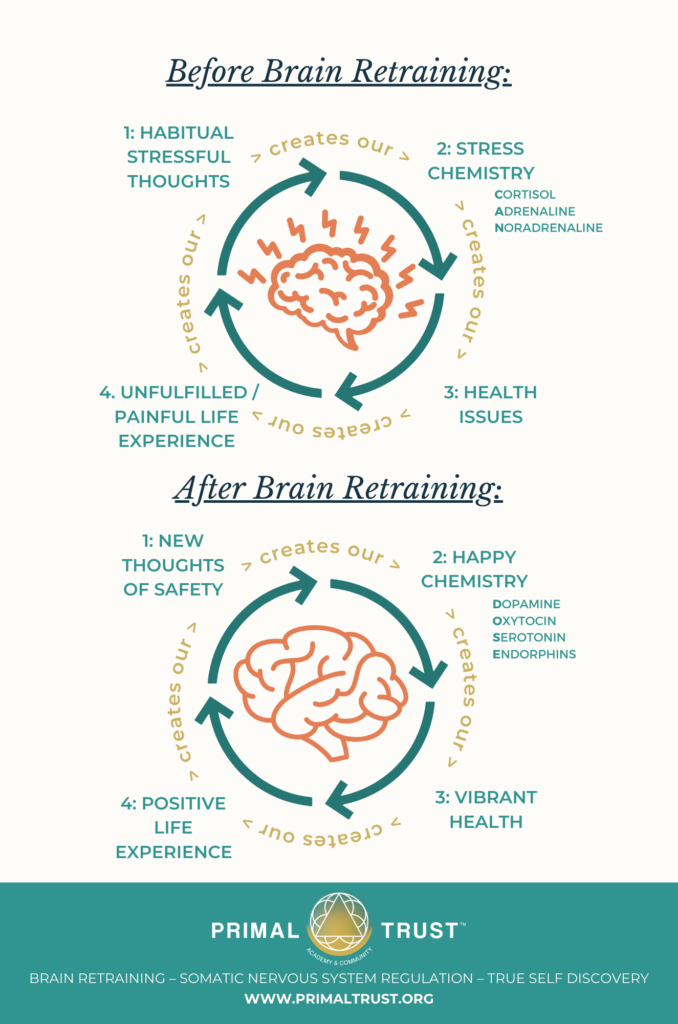
This infographic visually contrasts the effects of brain retraining on mental and physical well-being. It shows how shifting from stress-based thinking to safety-based thoughts rewires the brain through neuroplasticity, promoting health, happiness, and smarter daily functioning.
Train Attention Like You Train Muscles
Just like your body gets stronger with regular exercise, your attention span grows with daily training. In a world of endless distractions—from social media to multitasking—focused attention has become a rare and powerful skill. The good news? It’s a skill you can develop deliberately, using the principles of neuroplasticity.
Think of your focus like a mental muscle. Every time you practice sustaining attention—whether it’s on a task, a breath, or an object—you’re building concentration “muscle memory” in your brain. Over time, these neural circuits become stronger, making it easier to stay present and tune out distractions.
One simple but powerful technique is focused-attention meditation. For example, sit still and direct your gaze at a single object—like a candle flame or even a dot on the wall—for 60 seconds. Let your breath flow naturally. When your mind wanders (which it will), gently bring it back. That single act of returning focus is what strengthens your attention muscle.
Research shows that just 10 minutes of mindfulness practice a day can improve attention and working memory over time. Apps like Headspace or Insight Timer offer guided sessions to get you started.
The key is consistency. You wouldn’t expect to build biceps with one push-up—and the same goes for mental strength. Daily “reps” of focused attention, even just for a minute or two, begin to rewire your brain for greater clarity, calm, and cognitive control.
Use Your Breath to Interrupt Old Patterns
Have you ever caught yourself spiraling into overthinking, fear, or self-doubt—without knowing how to stop? That’s your brain running on deeply embedded loops, built from past experiences and reinforced by repetition. These automatic patterns often hijack your focus, confidence, and creativity. But there’s a simple, powerful tool that can help you break them: your breath.
Breathing is one of the few physiological functions that you can control consciously. And when used with intention, it acts as a biological reset button. Deep, rhythmic breathing sends signals to your nervous system that you’re safe, reducing the fight-or-flight response governed by the amygdala. This creates space for better decisions, calmer reactions, and sharper thinking.
For instance, box breathing—inhaling for 4 seconds, holding for 4, exhaling for 4, and pausing again—can slow your heart rate and clear mental clutter in less than a minute. Techniques like diaphragmatic breathing or alternate nostril breathing (used in yoga) also balance both hemispheres of the brain and enhance focus.
When you consciously breathe, you interrupt the brain’s default mode network—the system responsible for mind-wandering and self-referential thoughts. This break allows the prefrontal cortex (the decision-making hub) to regain control, empowering you to choose a different, more productive response.
You don’t need a meditation mat or silence. Just pausing for three deep breaths in the middle of a stressful moment can shift your mental state. Over time, these small pauses help rewire your brain’s reaction patterns, replacing impulsive loops with clarity and calm.
Your breath is more than just survival—it’s a built-in tool for transformation.
Small Changes Add Up Fast
When it comes to rewiring your brain, you don’t need a complete life overhaul. In fact, neuroscience shows that consistent, small daily actions are the most effective way to create lasting change. Your brain is always listening, and even the tiniest shift in behavior sends a powerful message: “We’re doing things differently now.”
Each time you pause before reacting, take a conscious breath, or focus on a single task, you are reinforcing a new neural pathway. One calm decision a day—like choosing to respond with patience instead of frustration—may seem minor, but over time, it reshapes your emotional circuitry.
This process is known as long-term potentiation—the strengthening of connections between neurons through repeated use. The more often you activate a new behavior, the stronger and faster that brain pathway becomes. It’s how habits form and how identity shifts. You’re not just acting calm—you start becoming a calmer person.
After just 30 days of consistent micro-actions, people often report noticeable improvements in clarity, emotional resilience, and reduced stress levels. That’s because neuroplasticity rewards consistency, not intensity. It’s not about grand gestures; it’s about repeating the right ones, no matter how small.
Apps like Habitica, Streaks, or even a sticky note on your desk can help you stay accountable. Over time, these daily shifts compound, much like interest in a savings account—except you’re investing in a more focused, balanced, and powerful brain.
Remember, genius isn’t built in a day—it’s built in moments. Stack those moments with intention, and your brain will do the rest.
Don’t Wait to “Feel Motivated”—Rewire It
We often imagine motivation as a lightning bolt—sudden, inspiring, and powerful. But in reality, motivation doesn’t just appear out of nowhere. It’s a byproduct of action, not the starting point. If you sit around waiting to “feel ready,” your brain will default to its comfort zones and old habits. But if you take even a small step forward, your brain begins to build momentum.
Neuroscience backs this up. When you complete a task—no matter how minor—your brain releases dopamine, a feel-good chemical that reinforces behavior and increases your drive to do more. This creates a positive feedback loop: action sparks reward, which increases motivation, which leads to more action.
This is especially relevant to neuroplasticity. The brain rewires through repetition and consistency, not occasional surges of inspiration. Each time you show up—whether it’s for 5 minutes of focus training, a breathing exercise, or journaling—you strengthen your brain’s ability to keep showing up. Over time, this daily discipline becomes part of your identity.
The secret is to lower the barrier to starting. Use the “2-minute rule”: begin with something so small it feels effortless—like opening a notebook or taking one conscious breath. That small act bypasses resistance and flips your brain from passive to active mode.
Tools like Notion, TickTick, or habit trackers like Loop can help you visualize your consistency and keep you accountable.
Remember: motivation follows motion. By showing up consistently, even when you don’t feel like it, you’re literally teaching your brain that this is who you are now. You’re not waiting to feel like a genius—you’re building the neural scaffolding to become one.
I Rewired My Brain With Just 5 Minutes a Day
You don’t need hours of meditation, elaborate routines, or complete lifestyle overhauls to start changing your brain. In fact, I began my own transformation with just five intentional minutes a day—and the results were profound.
Each morning, I started with a simple habit: conscious breathing followed by setting a clear intention for how I wanted to show up that day—calm, focused, and resilient. Some days, I added a 60-second attention drill, like staring at a candle flame or repeating a grounding phrase like “I am present.” These tiny moments became anchors throughout my day.
At first, it didn’t feel like much. But after a week, I noticed I was less reactive in stressful situations. I didn’t spiral into self-doubt as quickly. After a month, my ability to focus deepened. I stopped checking my phone every 10 minutes. I could sit and work for an hour straight without zoning out. That’s neuroplasticity in action—the brain adapting to what you repeatedly do.
Science backs this up. Even brief daily meditation has been shown to improve emotional regulation, reduce anxiety, and strengthen gray matter in areas of the brain linked to learning and memory. And because I kept my practice short and achievable, I was consistent—consistency being the real secret to rewiring the brain.
I didn’t need a therapist, a retreat, or a perfect mindset. Just five minutes a day, done with intention, shifted how I thought, reacted, and made decisions. Over time, those minutes built a new version of me—one that felt calmer, clearer, and more in control.
If I can rewire my brain in five minutes a day, so can you. Start small. Stay steady. Watch your mind transform.
Your Genius Mind Is Already There—You Just Have to Train the Access
You don’t need to become a genius—you already are one. The potential for creative problem-solving, deep focus, emotional intelligence, and innovative thinking already exists within your brain. The key is to train your mind to access those abilities more often and more efficiently.
Genius isn’t just about IQ—it’s about how you use your mind. Neuroscience shows that traits we associate with genius—like working memory, sustained attention, and complex thinking—can all be strengthened through neuroplasticity. You’re not “adding” intelligence, you’re uncovering layers of it by rewiring your focus, managing your energy, and regulating your emotions.
Think of your brain as a high-powered computer that’s running too many background apps. By practicing techniques like mindfulness, breathwork, and single-tasking, you free up cognitive resources and reduce mental noise. This allows your brain to enter flow states—periods of deep immersion where your highest thinking unfolds.
Tools like Brain.fm, Notion, or Pomodoro-based focus sessions can help structure your environment to support these peak states. But it starts with how you train your brain each day.
Energy also plays a huge role. When you eat well, sleep deeply, and move your body regularly, you support the biological foundation of cognitive performance. Neuroscientific research shows that even 20 minutes of aerobic exercise can boost executive functioning and memory—both core components of genius-level thinking.
So don’t wait for brilliance to strike like lightning. Cultivate it. Rewire your focus, direct your energy, calm your emotions, and give your genius mind the environment it needs to thrive. You already have the hardware—now it’s time to optimize the system.
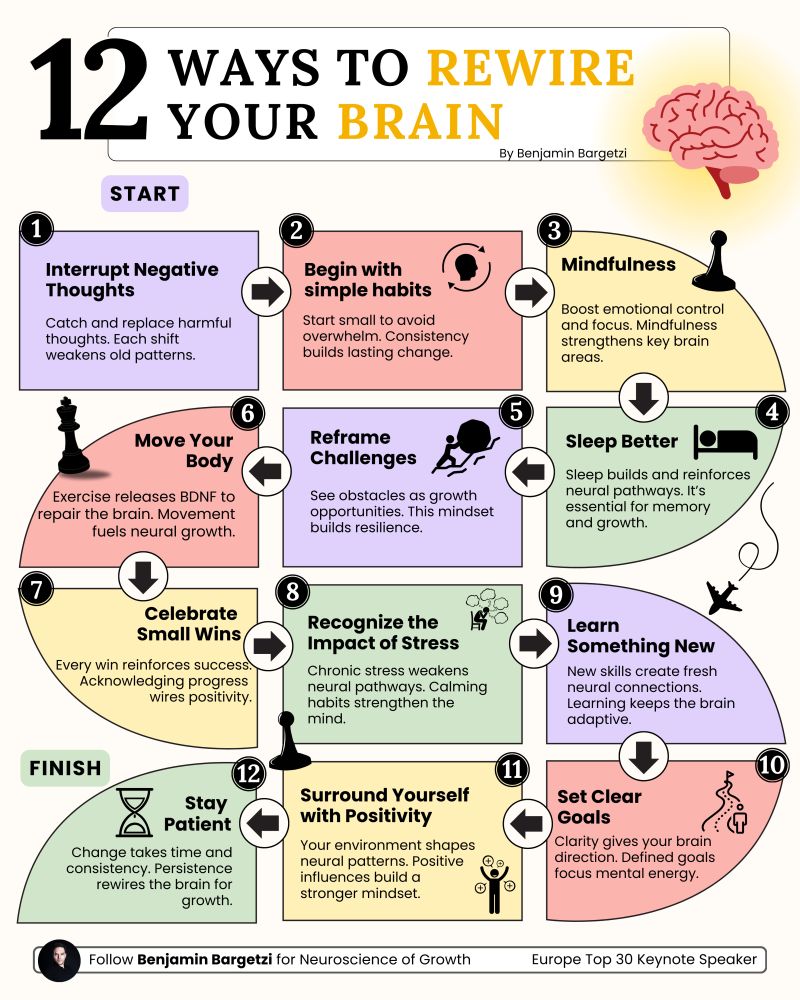
This infographic outlines 12 practical steps to rewire your brain using the science of neuroplasticity. From interrupting negative thoughts to learning new skills, each habit strengthens neural connections that support genius-level growth.
Rewire Daily, Rise Daily
Neuroplasticity proves that your brain is not fixed—it’s fluid, adaptable, and ready to grow with you. By making small, intentional choices each day—like focusing your attention, calming your breath, or challenging your thoughts—you’re actively rewiring your brain for clarity, creativity, and resilience.
The tools of transformation are already within you. With consistency and mindful practice, you’re not just building habits—you’re building intelligence.
You don’t need to chase genius. You train it. You live it. And your brain? It evolves with every moment you choose growth.
FAQs On Rewire Your Brain for Genius: How Neuroplasticity Can Make You Smarter Every Day
What is neuroplasticity?
Neuroplasticity is the brain’s ability to reorganize itself by forming new neural connections throughout life, allowing it to adapt, learn, and change in response to experience.
Can adults really rewire their brains?
Yes, research shows that adults can develop new neural pathways through consistent practice, learning, and habit changes—even well into old age.
How does neuroplasticity make you smarter?
By strengthening useful neural pathways and weakening unhelpful ones, neuroplasticity enhances memory, focus, emotional control, and problem-solving abilities.
What are the first steps to rewiring your brain?
Start with small, consistent habits like mindfulness, focused attention exercises, deep breathing, and reducing mental distractions.
Does meditation really change your brain?
Yes, studies show that mindfulness and meditation can increase gray matter density and improve areas related to focus, empathy, and emotional regulation.
Can breathing exercises affect brain function?
Absolutely. Deep, controlled breathing activates the parasympathetic nervous system and helps interrupt stress-based neural patterns.
How long does it take to rewire the brain?
Even 30 days of consistent, intentional practice can lead to measurable brain changes, though deeper rewiring can take longer depending on the habit.
Is intelligence fixed, or can it grow?
Intelligence is not fixed. With effort and neuroplasticity-based techniques, cognitive abilities can grow over time.
Can I become more creative through brain training?
Yes. Practices like free writing, divergent thinking tasks, and reducing mental clutter help activate neural networks associated with creativity.
What role do habits play in neuroplasticity?
Habits are powerful drivers of neuroplastic change. Repeating a behavior consistently strengthens the neural circuits responsible for it.
Is multitasking good for the brain?
No. Multitasking often leads to reduced focus and weaker memory retention. Single-tasking builds stronger attention pathways.
Does sleep impact brain rewiring?
Yes, quality sleep is essential. It consolidates learning and memory and allows the brain to strengthen newly formed connections.
Can I undo negative thought patterns with neuroplasticity?
Yes. With awareness, reflection, and repeated positive thinking, the brain can replace negative patterns with healthier ones.
Are there any tools or apps to help rewire the brain?
Yes. Apps like Headspace, Lumosity, and Brain.fm support focus, meditation, and cognitive training.
Does physical exercise influence neuroplasticity?
Definitely. Regular aerobic exercise boosts brain-derived neurotrophic factor (BDNF), which supports learning and neural growth.
How does attention training work?
By practicing focused tasks—like staring at an object, doing puzzles, or meditating—you train your brain to resist distraction and stay present.
Is journaling helpful for brain rewiring?
Yes. Reflective journaling helps you become aware of thought patterns and redirect your mental energy in more productive ways.
Can neuroplasticity help with anxiety or overthinking?
Yes. Practices like breathwork, mindfulness, and cognitive reframing can rewire the brain to reduce anxiety responses and foster calm.
Do children benefit from neuroplasticity too?
Children’s brains are naturally more plastic, which makes early habits and environments especially powerful in shaping long-term intelligence and behavior.
What’s the most important thing to remember about neuroplasticity?
Your brain is always changing. Every thought, action, and habit is shaping it—so choose consciously, practice consistently, and progress is inevitable.
-Authored By Pragna Chakraborty