

Mindfulness Improves Focus, So You Read Faster
Most students struggle with focus while reading—not because they lack intelligence, but because their minds are overstimulated. Practicing mindfulness helps train your attention to return to the present moment. This simple habit reduces mental chatter and lets you stay immersed in the text. Over time, your eyes and brain synchronize better, making reading smoother and more efficient.
Research from Harvard University shows that mindfulness increases grey matter in areas related to focus and memory. This structural brain change directly impacts your ability to comprehend what you’re reading in one go. Instead of re-reading the same lines, you absorb more in fewer minutes. That’s why students who meditate regularly often find studying less exhausting.
When you practice mindfulness daily—even for just 10 minutes—it creates what’s called attentional stability. This means fewer mental distractions while processing study material. With each breath-focused session, you’re building your brain’s resistance to wandering thoughts and external interruptions. That translates into faster reading with better retention—especially for dense topics.
Let’s say you’re reading a complex chapter in physics. If your mind is half-occupied with anxiety or notifications, your cognitive load increases. Mindfulness reduces this overload by filtering unnecessary inputs and improving working memory. This lets you stay fully engaged, allowing quicker understanding with fewer study interruptions.
Moreover, mindfulness isn’t just a tool for stress reduction—it’s a skill that optimizes how you process academic content. Regular breathing exercises or mindful reading enhance your ability to scan, comprehend, and reflect with intention. This deep engagement prevents shallow reading, which often leads to forgetting key details during exams. Your reading speed improves not from rushing, but from presence.
Try this simple practice: before every study session, pause for 2 minutes and do a guided breath meditation. This ritual acts as a cognitive reset, anchoring your mind to the page. You’ll notice how easier it is to enter flow and finish chapters faster. Over time, this becomes your personal shortcut to focused, efficient learning.
Less Distraction = More Understanding in Class
Most students think they’re paying attention in class, but their minds often drift without them realizing. Mindfulness training increases your ability to detect when your focus has slipped. By returning attention to the present, you naturally absorb more information during lectures. This improves comprehension without taking extra notes or reviewing more later. Distraction awareness is a skill you can sharpen with simple practice.
Mindfulness creates what’s known as meta-awareness—the ability to notice your thoughts in real time. When you’re aware you’re zoning out, you can bring your attention back before missing anything important. This sharpens real-time comprehension, especially in complex subjects like math or science. It’s why students who meditate tend to follow lectures more easily, even in fast-paced classes. You’re training your brain to catch itself mid-distraction.
Distractions aren’t always external—they can be internal, like worry or self-criticism. Mindfulness reduces this kind of mental noise by anchoring your thoughts in the present moment. This makes it easier to stay connected to the teacher’s words rather than spiraling into unrelated thoughts. Research confirms that mindful students report more clarity and less cognitive fatigue during long academic sessions.
One overlooked benefit of mindfulness is how it enhances active listening. Rather than just hearing words, you begin to engage with tone, emphasis, and structure. This helps your brain organize new information faster and with more context. Over time, your in-class understanding improves to the point where post-class revision takes less time. You’re learning deeper with fewer hours.
In group discussions or project work, mindful attention makes you more present, empathetic, and quick to understand perspectives. That means fewer miscommunications and a better grasp of the subject. You also ask better questions, since you’re attuned to subtle gaps in understanding. This level of engagement sets you apart from passive learners who are physically present but mentally scattered.
To boost your classroom focus, try a short pre-class meditation or body scan. These simple techniques help shift your nervous system from distracted mode to focused mode. Pair that with mindful breathing during lessons, and you’ll catch yourself zoning out less often. The result: clearer understanding, fewer doubts, and stronger academic performance—all without studying more.
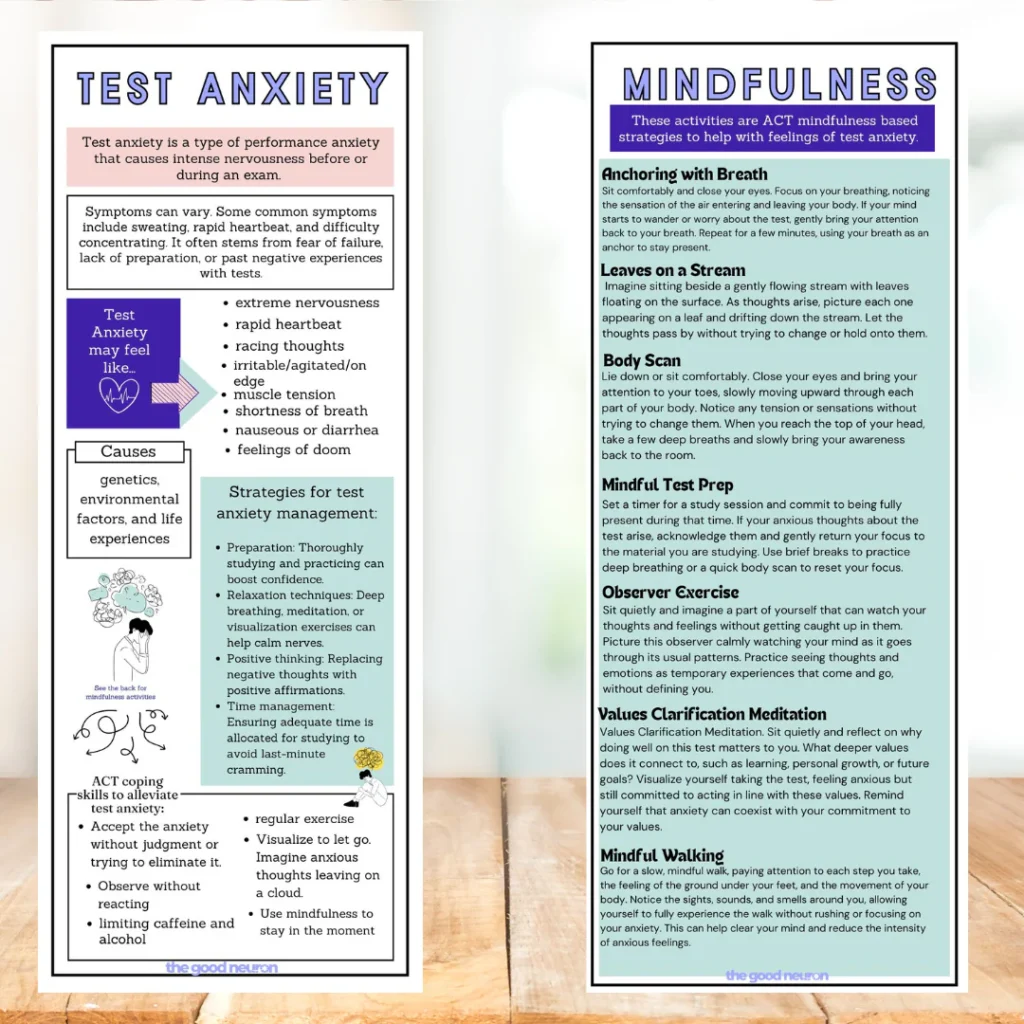
This infographic offers practical mindfulness-based strategies to manage test anxiety, from breathing techniques to visualization exercises. It clearly contrasts symptoms and causes of anxiety with actionable coping tools for students.
Calm Mind = Better Memory Retrieval
Have you ever blanked out during an exam, even though you studied the material? That’s often a sign of stress-induced memory blockage. When your brain feels threatened, the amygdala activates a fight-or-flight response, disrupting the hippocampus—your memory center. Mindfulness calms this reactive loop, creating the mental space to retrieve information clearly.
Regular mindfulness practice strengthens your brain’s ability to regulate emotions, which is key for memory access under pressure. A calm brain engages the prefrontal cortex more efficiently—the region responsible for recall and decision-making. Studies show that mindfulness improves working memory, especially when practiced consistently over time. This is why even short daily sessions yield exam-day benefits.
In high-stress environments like timed tests, your cognitive clarity depends on your physiological state. Breath-based mindfulness helps stabilize your nervous system, making it easier to remember what you learned. It essentially shifts your brain from panic mode into performance mode. This works particularly well with subjects requiring sequential thinking, like math or physics. It also improves your ability to filter distractions that can interrupt memory retrieval.
Mindfulness doesn’t just improve recall during exams—it also enhances long-term memory consolidation. That means the more calmly and attentively you study, the deeper the content embeds in your brain. Over time, calm focus helps you connect ideas more intuitively, especially during problem-solving tasks.
You stop depending on last-minute cramming and start trusting your internal clarity. With regular practice, mindfulness actually enhances conceptual recall as well.
Many students unknowingly sabotage memory by studying in a state of anxiety. But when you learn in a calm, focused mindset—made possible through mindfulness—you’re engaging what’s called deep encoding. This improves both retention and retrieval.
The act of being present sharpens the clarity of how you learned it in the first place. Studies show mindfulness even improves episodic memory, making you better at remembering facts in context. It also helps with retrieval fluency, especially under time pressure.
Before recalling complex information, take 30 seconds to do a breathing reset. Inhale slowly, exhale even slower, and center your attention. This moment of awareness can unlock material that otherwise feels “just out of reach.” When combined with visualization techniques, it becomes even more powerful. With consistent use, you’ll start trusting your calm mind more than chaotic last-minute revisions.
Slowing Down Your Breath = Speeding Up Your Thinking
It may sound counterintuitive, but slowing your breath can actually make your mind think faster. When you breathe slowly and deeply, it activates the parasympathetic nervous system, helping calm the body and sharpen mental clarity. This physical shift enhances your brain’s ability to process and retain information. That’s why breathwork is a growing tool among peak performers.
Slower breathing improves oxygen delivery to the brain, fueling sharper and more efficient thinking. It boosts executive function, which governs decision-making, task-switching, and problem-solving. On the other hand, shallow breathing triggers cortisol release, impairing cognition. Deep breathing does the opposite, enabling better mental clarity.
Mindfulness of breath slows your internal clock, allowing you to observe your thoughts before reacting. This not only increases processing speed but also reduces impulsivity and errors. Many students report that after just a few minutes of mindful breathing, mental fog lifts, allowing clearer engagement with complex topics. It’s one of the simplest tools to sharpen thinking on demand.
When your brain is calm, it’s easier to access higher-level thinking. Controlled techniques like box breathing or 4-7-8 breath activate the regions responsible for mental flexibility, helping you stay sharp under pressure. These practices also improve attention span and reduce emotional reactivity in exams.
Studies show that even a short session of breath awareness boosts problem-solving accuracy. This is because a calm brain forms faster neural connections and allows for more integrated thinking. Regular breathwork helps balance brain hemispheres, leading to better creative and analytical output. Students also report better mental clarity and quicker thought formation.
To try it, start with a few rounds of box breathing. Inhale for 4 seconds, hold for 4, exhale for 4, and hold again. This activates a cognitive reset and stabilizes focus. Add visualization or light movement to the routine for better results. You’ll soon experience sharper thinking without needing more study time.
5 Minutes of Breath Before Studying Saves an Hour
Most students jump straight into study sessions without preparing their minds, leading to wasted time and shallow focus. Taking just 5 minutes of mindful breathing before studying can drastically boost mental readiness. This short pause lowers cognitive clutter, helping you approach tasks with greater clarity. It’s like sharpening your tools before using them.
A brief breathing session improves your brain’s information retention by aligning attention and intention. When your body is calm and focused, learning becomes easier and more efficient. This approach reduces the need for repetition and boosts deep learning. That’s why many high achievers build breath awareness into their study rituals.
Pre-study breathwork is particularly effective at reducing procrastination. It brings your attention to the present task instead of letting your mind wander. In just a few minutes, you can shift from avoidance to engaged action. Techniques like diaphragmatic breathing prepare your brain to focus longer and deeper.
Incorporating a mindful pause before study helps activate the task-positive network—the brain system responsible for active focus and problem solving. This reduces reliance on willpower, which gets depleted over time. Breath awareness also calms the default mode network, which is active during daydreaming and rumination. The result? You start your session in “flow,” not friction.
Practicing mindful breathing before studying creates a psychological cue—a mental “on-switch” that signals your brain to enter learning mode. Over time, your brain associates this practice with focused performance. It also enhances neural efficiency, so you can do more in less time. Even one week of this routine can yield noticeable academic gains.
Try setting a timer for just 5 minutes, close your eyes, and focus on deep inhalations and exhalations. Use a simple technique like box breathing or 4-7-8 breath to anchor your attention. You’ll likely find you absorb more, retain better, and study faster—without increasing your hours. It’s the simplest upgrade to your study game, backed by neuroscience.
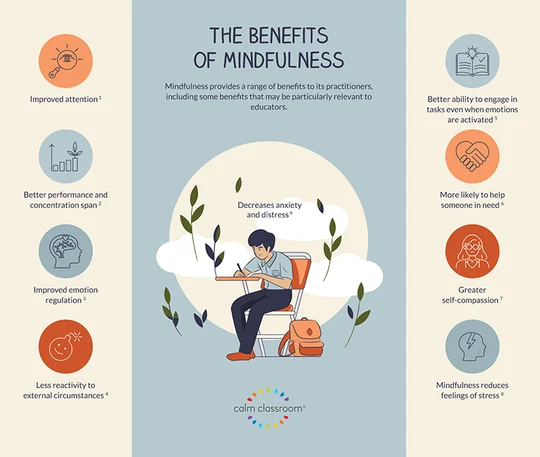
This infographic highlights the wide-ranging benefits of mindfulness, such as reduced anxiety, improved attention, and greater emotional regulation. It’s a concise visual summary of how mindfulness positively impacts mental well-being and academic performance.
Mindful Awareness Reduces Silly Mistakes
Silly mistakes—like misreading questions or skipping steps—often stem from autopilot behavior. Practicing mindful awareness helps you stay present with each task, catching errors before they occur. When you’re aware of what you’re doing as you’re doing it, your accuracy improves. This is especially helpful in exams, where tiny oversights can cost marks.
Mindfulness meditation trains the brain to notice when attention drifts and gently bring it back. This strengthens your ability to stay focused through repetitive or high-pressure tasks. Research shows that even brief practice boosts attention to detail, reducing errors across academic and real-life settings. It’s not about working harder—it’s about being mentally present.
Students often lose marks not because they didn’t know the material, but because they clicked the wrong option or forgot to double-check. Mindfulness slows down your reactions just enough to catch these automatic errors. By becoming aware of your tendencies—like rushing or zoning out—you begin to self-correct before making a mistake. It’s a simple shift that delivers measurable results.
At the neurological level, mindfulness enhances error-related negativity (ERN), a brain signal that helps detect and correct errors. Studies show this mechanism is stronger in mindfulness practitioners, improving decision-making under time pressure. It also improves response inhibition, so you don’t act impulsively on exams. This awareness leads to fewer careless errors and stronger performance across the board.
In math or coding, where logic chains matter, one skipped symbol or step can derail your whole answer. Mindful students develop the habit of pausing briefly before moving to the next line. This enhances cognitive control, helping them review without overthinking. It’s a balance between focused attention and relaxed awareness—hallmarks of high performers.
You can apply this by doing a 3-second breath-check after answering each question. This moment resets your brain and allows a quick internal review. It also activates the prefrontal cortex to assess logic and accuracy. Over time, these micro-pauses become automatic, leading to fewer mistakes and higher test scores. It’s not extra studying—it’s smarter awareness.
Reflection Builds Better Revision Strategies
Many students revise without first thinking about how they learn best. Mindful reflection allows you to step back and assess what revision methods truly work for you. It helps you notice patterns—like which techniques aid retention or where your energy dips. This awareness leads to more efficient study planning.
When you pause after each study session to reflect, you strengthen what’s called metacognition. This is the ability to think about your thinking. It lets you evaluate if your revision method—like flashcards, note-making, or summarizing—is truly effective. Mindful learners continuously tweak their approach based on real feedback, not just habit.
Reflection also builds emotional awareness, helping you detect when stress is interfering with productivity. Mindfulness reduces the chance of slipping into ineffective patterns, like re-reading passively or over-highlighting. It pushes you to ask: “Was that focused time, or just time spent?” This leads to smarter, more intentional revision.
Over time, this practice enhances your cognitive flexibility, making it easier to switch strategies when something isn’t working. Students who reflect regularly are more likely to adopt evidence-based study methods, like spaced repetition and retrieval practice. It also boosts your ability to self-monitor, which is key to making real academic progress.
Mindfulness invites you to review not just what you learned, but how you approached learning. This level of insight helps prevent mental burnout and builds stronger, more sustainable routines. It’s like doing a post-match analysis after every study game—identifying what worked and what didn’t. The result is a more refined, effective revision system tailored to your learning style.
You can start with a simple end-of-day practice: jot down which subjects felt easiest to focus on, and why. Reflect on what boosted your retention and what distracted you. Over time, you’ll build a personalized, high-efficiency revision strategy that aligns with your brain. Pair this with mindful journaling or self-checks to strengthen the habit. The more you reflect, the more precise and powerful your study routine becomes.
Exam Panic Reduces with Just One Technique
When panic strikes during an exam, your ability to think clearly collapses. But there’s one simple, proven method to stop that spiral: mindful breathing. Just a few breaths can activate your body’s calming system, lower your heart rate, and bring you back to center. It’s a powerful antidote to test anxiety.
This works because mindful breathing directly engages the parasympathetic nervous system, which counters the fight-or-flight stress response. Your brain shifts from survival mode to problem-solving mode. That change is critical for restoring access to memory and logic. Even two minutes of breathwork can reverse exam panic symptoms in real time.
Research shows mindfulness lowers levels of cortisol—the stress hormone that clouds thinking and triggers blank-outs. Students trained in breath awareness experience fewer moments of panic and greater control under pressure. That’s why many academic coaches now teach mindful grounding techniques as part of test prep.
Mindfulness also improves your ability to recognize when anxiety is rising before it takes over. This early detection—known as interoceptive awareness—gives you the chance to intervene. Instead of spiraling, you pause, breathe, and refocus. It also activates the prefrontal cortex, helping you regain logical control over the situation. That’s why breath-focused mindfulness works even when logic fails.
During high-stakes exams, this technique becomes your internal safety net. Breath regulation boosts cognitive performance, improves working memory, and increases attentional control. Students who regularly practice mindfulness report fewer physical symptoms of panic—like racing heart, sweating, or breathlessness—during timed tests.
To try it, build a habit of exam-day breathwork. Start your paper with 3 cycles of deep breathing: in for 4 seconds, hold, out for 6 seconds. Combine it with body scanning to relax tension and signal calm to the brain. This simple technique can transform your response to exam stress—without extra study, notes, or formulas. Just your breath, your awareness, and your control.
Mindfulness Improves Sleep—Which Improves Recall
Students often underestimate how critical sleep quality is to academic performance. During deep sleep, your brain consolidates what you’ve studied, transferring short-term input into long-term memory. Mindfulness practices before bedtime improve both the depth and duration of rest. That’s why mindful students often wake up with clearer recall.
Mindfulness helps calm the nervous system, reducing the overthinking and rumination that keep many students awake. It lowers levels of cortisol, the stress hormone that disrupts sleep cycles. Even a 10-minute body scan meditation can trigger the relaxation response needed to fall asleep faster.
Studies have found that students who practice mindful breathing experience fewer sleep disturbances and better dream recall. More importantly, they retain more of what they’ve studied. That’s because REM sleep plays a key role in memory integration, and mindfulness increases the chance of entering and sustaining REM.
Poor sleep compromises working memory, decision-making, and attention span. But regular mindfulness improves sleep efficiency, meaning more of your sleep time is restorative. This leads to sharper recall and better academic outcomes—even if your study hours stay the same. It also reduces dependency on caffeine and stimulants, which can further disrupt rest.
Practicing mindfulness before bed doesn’t require much effort. A short session of progressive relaxation, where you release tension from each part of your body, prepares your mind for deep sleep. You can also try mindful journaling to let go of anxious thoughts before lights out. These habits enhance neural recovery and create stronger cognitive connections overnight.
If you find yourself mentally foggy during morning revision, chances are your brain didn’t get enough recovery. Try a nightly routine that includes breath-focused meditation, screen-free time, and a gratitude reflection. These mindful habits improve both your mental clarity and your memory retention—without needing extra revision the next day.
Top Scorers Don’t Just Study—They Self-Regulate
Top-performing students rarely rely on last-minute effort alone—they practice self-regulation to manage their learning and emotions consistently. This involves setting goals, monitoring progress, and adjusting tactics when needed. Mindfulness enhances self-regulation by increasing self-awareness, allowing students to make smarter, more adaptive choices. It’s how they stay efficient and calm under pressure.
Students who self-regulate tend to resist distractions, manage stress better, and avoid burnout. Mindfulness builds this ability by sharpening moment-to-moment awareness. You begin noticing when focus slips, when you’re overwhelmed, or when your approach isn’t working. These cues help you take corrective action early—before things spiral into ineffective study habits.
Mindful learners are more likely to use strategies like time-blocking, reflection, and active recall because they’re tuned into what their brain actually needs. Instead of forcing through fatigue or distraction, they pause, reset, and return with greater clarity. This is the kind of mental discipline that separates average performance from excellence.
From a neuroscience perspective, mindfulness strengthens the prefrontal cortex, the region responsible for executive functioning and planning. It also reduces limbic system overactivation, which drives emotional reactivity. This balance allows top scorers to stay focused and adaptive even in high-pressure academic environments. They’re not just working hard—they’re working consciously.
Over time, mindfulness builds grit and resilience, helping students stick with long-term goals without falling apart during short-term failures. They can bounce back from bad grades, improve flawed strategies, and sustain motivation. This ability to self-regulate isn’t just good for school—it’s a core trait of long-term success across careers and life.
To build this trait yourself, try integrating daily check-ins, where you ask: What’s working? What needs adjusting? Pair it with mindful breaks, breath resets, and end-of-day journaling. These small actions build an inner system of accountability, leading to smarter, faster, and more fulfilling learning—just like the top scorers you admire.
Frequently Asked Questions on How Mindfulness Improves Exam Scores Without Studying More
How does mindfulness help me read faster without rushing?
Mindfulness sharpens focus and reduces mental distractions, helping you stay fully present with the text. This makes comprehension more immediate, so you spend less time re-reading.
Can being mindful really improve my concentration in class?
Yes, mindfulness trains your brain to stay anchored in the moment, making it easier to follow lectures, absorb new concepts, and reduce zoning out during lessons.
Why is a calm mind better at remembering things?
A calm mind reduces the interference of stress hormones like cortisol, allowing your brain to retrieve stored information more clearly and quickly.
How can slowing down my breath actually speed up my thinking?
Slow breathing activates the parasympathetic nervous system, which reduces stress and enhances your brain’s ability to process, connect, and recall information more efficiently.
Is five minutes of mindful breathing really that effective before studying?
Absolutely. Even a short session can reduce mental clutter, sharpen your focus, and increase the effectiveness of the study session that follows—saving you time overall.
How does mindfulness reduce silly mistakes in exams?
By increasing awareness and reducing autopilot behavior, mindfulness helps you slow down just enough to catch misreads, skipped steps, or careless errors before submitting your work.
Can reflecting on how I study actually improve my revision?
Yes, mindfulness supports metacognitive skills, helping you evaluate what study methods work best for you and adapt your strategy based on real-time feedback.
How does mindfulness help me manage exam panic in the moment?
Mindfulness activates the body’s calming systems, like breath control and interoception, which reduce panic symptoms and restore cognitive clarity during stressful exam situations.
Why is sleep so important for memory, and how does mindfulness help?
Sleep consolidates learning into long-term memory. Mindfulness improves sleep quality by reducing anxiety, overthinking, and late-night restlessness—giving your brain better recovery time.
What’s the link between top scorers and mindfulness?
Top scorers often practice self-regulation, a skill strengthened by mindfulness. It helps them stay focused, manage emotions, and make strategic decisions about how and when to study.
Can mindfulness replace study time altogether?
No, mindfulness doesn’t replace studying—but it optimizes the way you study, helping you absorb and retain more in less time, and reducing the need for repetitive cramming.
Does mindfulness make a difference even if I start close to exams?
Yes. Even short-term mindfulness practices can lower anxiety, improve recall, and sharpen focus, making them valuable tools right up to exam day.
What kind of breathing techniques are best for students?
Techniques like box breathing, 4-7-8 breath, and diaphragmatic breathing are all simple, effective methods that calm the mind and prime the brain for learning.
Is mindfulness useful only for written exams, or also for practicals and orals?
It’s useful for all types. Mindfulness enhances presence, memory, and emotional regulation, which are essential for staying composed and clear in oral exams or hands-on assessments.
Can mindfulness help if I have ADHD or struggle with attention?
Yes, several studies have shown that mindfulness can improve attention span, impulse control, and executive functioning in students with attention difficulties.
Do I need an app or guided session to practice mindfulness?
While apps can help, you don’t need them. Simple techniques like mindful breathing or body scans can be done anywhere, even silently before a class or during an exam.
What’s the best time to practice mindfulness for academic benefit?
Right before studying, after studying for reflection, and before bed for better sleep. These key transition points make your learning stick better.
How long before I see results from mindfulness practice?
Many students report feeling more focused and calm within a week. Cognitive improvements like memory and reduced stress build steadily with daily practice.
Can I use mindfulness on exam day without anyone noticing?
Yes. Silent breathing exercises, mental body scans, and brief grounding techniques can be done discreetly at your desk or while waiting for the test to begin.
Is mindfulness just for academic success or life beyond exams too?
Mindfulness builds emotional intelligence, resilience, and cognitive control—skills that benefit relationships, careers, and overall well-being far beyond the classroom.
~Authored by Barsha