

The Collaboration Crisis: How Present-Moment Awareness is Redefining Team Success
In the modern workplace, a silent crisis is unfolding. According to Gallup’s State of the Global Workplace: 2023 Report, a staggering 44% of employees worldwide experience significant stress daily. This epidemic of burnout isn’t just a personal issue, it’s a direct threat to team cohesion, innovation, and the bottom line.
The culprit is often our “always-on” culture, a digital storm that leaves our minds fragmented and perpetually distracted. Think of the brain as a powerful computer running too many applications at once. The result is sluggish performance, frequent errors, and an eventual system crash. We attempt to counter this with more technology and process management, yet often overlook the most critical component, the human mind itself.
This is where mindfulness enters the boardroom, not as a vague wellness trend, but as a form of practical mental training. In its simplest, secular form, mindfulness is the skill of paying attention to the present moment on purpose and without judgment. It is a trainable technique for enhancing the very cognitive and emotional functions that underpin effective teamwork.
This article will demonstrate how integrating evidence-based mindfulness practices can tangibly improve team collaboration, foster psychological safety, and elevate overall performance. We will first explore the compelling neuroscience, then detail 15 corporate practices for teams, each supported by scientific findings and real-world case studies, offering a clear roadmap to building a more focused, resilient, and innovative workforce.
The Neuroscience of Collaboration: How Mindfulness Rewires the Brain for Teamwork
For decades, the adult brain was considered a fixed, unchangeable entity. However, groundbreaking research in neuroscience has revealed a far more dynamic picture through the principle of neuroplasticity. This concept establishes that our brains can physically change and reorganize themselves in response to our experiences and behaviors, much like a muscle grows stronger with consistent exercise. Mindfulness is one of the most potent forms of this mental workout.
At the forefront of this research is the work of neuroscientists like Dr. Sara Lazar at Harvard Medical School. Her studies, using MRI scans, have shown that regular mindfulness meditation can physically increase the gray matter density in the prefrontal cortex. This area, located just behind the forehead, acts as the brain’s CEO, governing complex functions like decision-making, planning, and focused attention. For a team, this means members with a stronger prefrontal cortex are better equipped to stay on task, solve complex problems, and avoid costly errors.

Simultaneously, this research reveals another critical change. The amygdala, the brain’s primal “threat detector” or alarm system, begins to shrink. An overactive amygdala is what triggers the fight-or-flight response, causing us to react impulsively to an aggressive email or critical feedback. Mindfulness practice effectively turns down the volume on this alarm, as validated by extensive work from institutions like the Center for Healthy Minds.
These neurological shifts translate directly into a more functional and cohesive team environment. An employee with better emotional regulation doesn’t lash out during a high-stakes discussion; instead, they can pause, consider the situation, and respond constructively. This single change is the bedrock of psychological safety, an environment where team members feel safe enough to voice ideas, admit mistakes, and take creative risks without fear of punishment or humiliation.
Ultimately, by training the brain to be less reactive and more aware, we build teams that are not just more productive, but also more empathetic. When individual minds are less consumed by their own internal chatter and stress responses, they have a greater capacity to listen deeply to colleagues and understand different perspectives. This creates a positive feedback loop, where better focus improves communication, which in turn strengthens team bonds and drives collective success.
From Theory to Practice: 15 Evidence-Based Mindfulness Techniques for the Modern Workplace
Understanding the neuroscience of mindfulness is the first step. The next is implementation. The following practices are not abstract ideals but concrete, actionable techniques that can be integrated into the daily workflow. They are grouped by their primary function, starting with the individual, moving to team communication, and culminating in organizational-level support.
A. Foundational Practices: Building Individual Focus
These initial practices are designed to build the core skill of attention control within each team member, forming the bedrock for more advanced team applications.
1. Leverage Guided Meditation Apps Companies are increasingly turning to platforms like Headspace for Work and Calm Business to provide accessible, structured training. These apps offer short, guided sessions that employees can use during a commute or a short break, effectively lowering the barrier to entry and making mindfulness a scalable corporate resource.
2. The “Mindful Minute” Kick-off Begin every meeting with 60 seconds of structured silence. This simple act serves as a cognitive reset, allowing team members to transition from their previous task and arrive fully present. It’s like rebooting a computer before running a complex program, ensuring everyone starts from the same focused baseline, leading to more efficient and productive discussions.
3. Encourage Mindful Breaks A mindful break is not about scrolling through social media. It involves stepping away from all screens and engaging the senses, perhaps by watching the clouds, listening to ambient sounds, or simply focusing on the physical sensation of walking. This practice is rooted in Attention Restoration Theory, which posits that such breaks can replenish our depleted cognitive resources.
4. Introduce the Body Scan The body scan is a foundational mindfulness exercise where one systematically brings gentle, non-judgmental attention to different parts of the body. This practice helps employees connect with the physical manifestations of stress, like a clenched jaw or tense shoulders, and consciously release that tension, leading to both mental and physical relief.
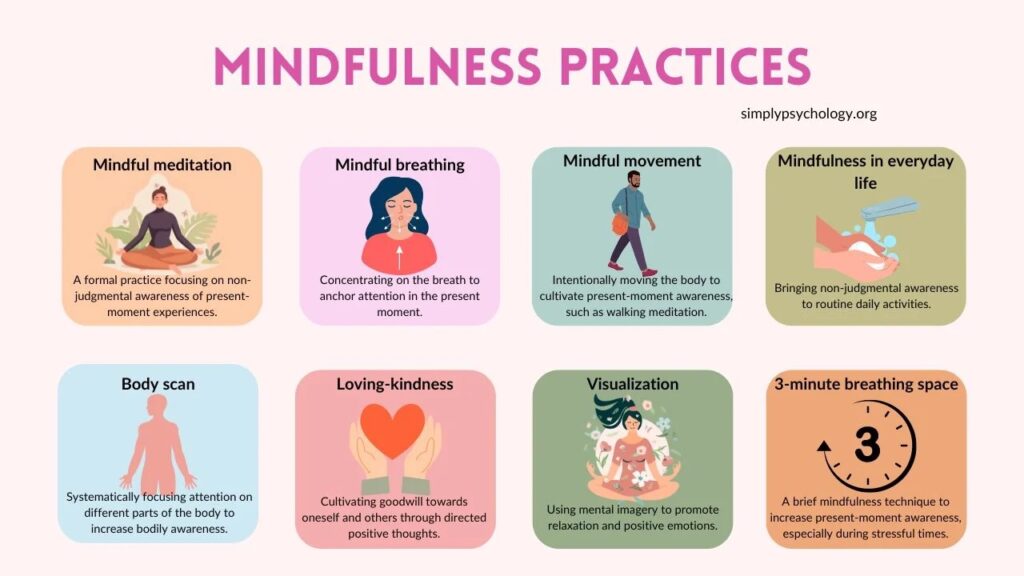
5. Practice Mindful Task-Switching The myth of multitasking has been thoroughly debunked; it’s actually rapid, inefficient task-switching. To counter this, teams can adopt a mindful protocol: before opening a new document or starting a new task, take one deep breath and mentally close the previous one. This simple habit prevents “attention residue,” where thoughts of the last task bleed into the new one, thereby improving focus and reducing errors.
B. Integrated Practices: Enhancing Team Communication
Once individuals have a basic grasp of attention, these practices integrate mindfulness directly into the fabric of team interaction, transforming communication.
6. Implement Mindful Listening Exercises In a simple paired exercise, one person speaks for two minutes while their partner listens without interrupting or even planning a response. The listener’s only job is to be fully present. This powerful technique trains the brain to absorb information without judgment, fostering genuine understanding and making team members feel truly heard.
7. Adopt “Mindful Speaking” Protocols Mindful speaking is the art of communicating with intention, clarity, and an awareness of one’s impact on others. During feedback sessions, for example, teams can be trained to use non-violent communication frameworks. This approach builds a culture of constructive dialogue, rather than one of criticism and defense.
8. Normalize the “Mindful Pause” Before Replying Create a team norm to take one deliberate breath before responding to a potentially triggering email or message. This small gap breaks the brain’s automatic stimulus-reaction circuit. This “buffer zone” is where emotional regulation happens, preventing knee-jerk reactions that can escalate conflict and damage team trust.
9. Start Meetings with Team Gratitude Sharing Dedicate the first two minutes of a weekly huddle for each person to share one specific thing they are grateful for professionally. As research from centers like UC Berkeley’s Greater Good Science Center shows, gratitude actively combats negativity bias. This practice shifts the team’s collective mindset towards appreciation and strengthens interpersonal bonds.
10. Use Mindful Problem-Solving When facing a challenge, encourage the team to adopt a “beginner’s mind” (Shoshin), a concept from Zen Buddhism. This involves intentionally setting aside preconceived notions and assumptions to see the problem as if for the first time. This technique breaks down cognitive rigidity and opens the door to more creative and innovative solutions.
C. Structural & Leadership-Driven Practices
For mindfulness to become truly embedded in a company’s culture, it requires structural support and visible buy-in from leadership.
11. Create Dedicated Quiet Spaces Designating a small, tech-free room for quiet reflection sends a powerful message that the organization values mental well-being. This physical space acts as a sanctuary, a “recharge station” where employees can step away from the chaos of the open office to meditate, breathe, or simply be still.
12. Sponsor Formal Mindfulness Workshops Bringing in certified mindfulness instructors for workshops elevates the practice from a personal hobby to a legitimate professional development skill. Expert-led training provides a solid foundation, ensures proper technique, and allows for a safe space where employees can ask questions and share experiences.
13. Champion Mindful Leadership Modeling Change is most effective when it starts at the top. As detailed in publications like the Harvard Business Review, when executives and managers openly discuss their own mindfulness practice and its benefits, it removes stigma and signals that mental fitness is a priority for leadership.
14. Conduct Mindful Performance Reviews Reframe the traditional performance review from a one-way judgment into a two-way, collaborative dialogue. A mindful approach uses curiosity and open-ended questions, focusing on learning and growth rather than past mistakes. This fosters a sense of partnership and reduces the anxiety typically associated with reviews.
15. Integrate Mindfulness into Onboarding Introduce the company’s well-being tools and mindful culture from day one. Including a short session on mindfulness and stress management in the new-hire orientation process communicates that employee well-being is a core value, not just a footnote, thereby improving engagement and long-term retention.
Mindfulness in Action: Case Studies from Industry Titans
The corporate adoption of mindfulness is no longer a niche experiment. It is a proven strategic initiative backed by measurable data from some of the world’s most successful companies. These organizations have moved beyond theory, investing in large-scale programs and reaping tangible rewards in productivity, employee well-being, and financial returns.
Google: Searching Inside for Better Leadership
Perhaps the most famous corporate mindfulness program, “Search Inside Yourself” (SIY), was born inside Google. Developed by engineer Chade-Meng Tan, the program was designed as an emotional intelligence curriculum with mindfulness at its core. The goal was to help Google’s brilliant engineers and leaders better understand and manage their own minds and emotions.
The results were transformative. Participants reported significant improvements in their ability to manage stress, lead with empathy, and maintain focus amidst distractions. The demand for SIY became so immense that it was spun off into an independent nonprofit, the Search Inside Yourself Leadership Institute, which now trains organizations worldwide. Google proved that investing in the inner-well being of employees could directly cultivate more effective and compassionate leadership.
Aetna: Calculating the Tangible ROI of Well-being
For a more direct look at the financial benefits, look to the health insurance giant Aetna (now part of CVS Health). Under the guidance of former CEO Mark Bertolini, Aetna offered free mindfulness and yoga classes to its 55,000 employees. The company then tracked the data, providing one of the clearest examples of a direct return on investment.
The findings, reported in numerous business publications, were stunning. Employees who participated reported a 28% reduction in their stress levels and a 20% improvement in sleep quality. Most compellingly, Aetna calculated that these improvements led to a gain of 62 minutes of productivity per employee, per week, which they valued at an average of $3,000 per employee annually. This demonstrated that mindfulness isn’t just a benefit, it’s a powerful productivity tool.
SAP: Scaling Mindfulness for Global Impact
German software corporation SAP showcases how mindfulness can be successfully scaled across a massive, global workforce. Their “Global Mindfulness Practice” program has reached over 25,000 employees and boasts a waiting list, demonstrating immense employee interest. The program includes guided meditations, online courses, and local community-building activities.
SAP’s leaders have rigorously measured the program’s impact. They calculated an estimated 200% return on investment, driven by improvements in employee engagement and a decrease in absenteeism. Their internal metrics, like the Business Health Culture Index, showed a marked increase for participants. For SAP, mindfulness has become a core element of their strategy to foster a more innovative, creative, and resilient culture in a fast-paced industry.

Beyond the Buzzword: Mindfulness as a Strategic Imperative
The evidence is clear and compelling. Mindfulness in the workplace is no longer a “soft skill” or a fleeting wellness trend, it is a powerful, science-backed business tool for building the resilient and innovative teams required to thrive in the 21st century. The journey from the MRI scans of the brain to the balance sheets of Fortune 500 companies tells a single, coherent story.
By training the mind to be more focused and less reactive, we are not just reducing stress, we are upgrading the entire operating system of our workforce. We are cultivating teams capable of deeper focus, more effective emotional regulation, and stronger interpersonal cohesion. Think of it as tuning an orchestra before a major performance; each musician must be individually focused and in sync for the group to create something extraordinary.
The path forward for any organization does not require a massive, instantaneous overhaul. It begins with a single, intentional step. Leaders are encouraged to view these practices not as an expense, but as a strategic investment in their most valuable asset, their people.
Start small. Introduce the “Mindful Minute” at the beginning of meetings this week. Share this article with your team. By planting these small seeds of awareness, you can begin to cultivate a more conscious, productive, and ultimately more human workplace culture. The future of work is not just about smarter technology, it’s about a more aware and centered workforce.
Frequently Asked Questions About Mindfulness at Work
What exactly is workplace mindfulness?
Workplace mindfulness is the practice of training your attention to be more aware of the present moment, without judgment. In a professional context, it’s a secular, science-backed skill used to improve focus, manage stress, and enhance emotional regulation, rather than a spiritual or religious practice.
Is mindfulness just another word for meditation?
Not exactly. Meditation is the formal practice you do to train your attention, like going to the gym for your brain. Mindfulness is the quality of awareness you develop from that practice, which you can then apply to any moment of your day, whether you’re in a meeting or writing an email.
Do you have to be religious or spiritual to practice it?
Absolutely not. The corporate mindfulness practices discussed in this article are completely secular. They are presented as a form of mental training, focusing on observable, scientific benefits like changes in the brain’s prefrontal cortex and amygdala.
How much time does this actually take?
It can take as little as one to five minutes a day. Practices like the “Mindful Minute” before a meeting or taking a short, focused break are designed to fit into a busy schedule. Consistency is more important than duration.
Isn’t this just a way for companies to make employees handle more stress?
That’s a valid concern. However, the goal of a genuine mindfulness program is not to help employees tolerate a toxic environment. It is to equip them with the skills to manage inevitable workplace pressures healthily, improve focus, and foster a more collaborative and psychologically safe culture for everyone.
What are the tangible business benefits?
Research and case studies from companies like Aetna and SAP show clear benefits, including increased productivity, reduced employee absenteeism, lower healthcare costs, and improved employee engagement and retention. It’s a direct investment in human capital.
How can we measure the success of a mindfulness program?
Success can be measured through a combination of methods. You can use confidential employee surveys to track self-reported stress levels and job satisfaction. You can also monitor key business metrics like productivity rates, employee turnover, and absenteeism before and after implementation.
What if our team is skeptical?
Start by focusing on the science, not the spirituality. Frame it as “attention training” and share the neurological evidence and business case studies. Starting with small, voluntary, and simple practices like a “Mindful Minute” can help demonstrate the benefits without being intimidating.
Do we need to hire an expert or can we do this ourselves?
You can start with simple, self-guided practices. However, for a more structured rollout, sponsoring a workshop with a certified mindfulness instructor can provide a strong foundation, lend credibility to the initiative, and ensure proper techniques are taught.
Will this work for remote or hybrid teams?
Yes, absolutely. Many practices are location-independent. Guided meditation apps, virtual “Mindful Minute” kick-offs on video calls, and mindful communication protocols for emails and chats are highly effective for distributed teams.
Is mindfulness only for reducing stress?
While it’s highly effective for stress reduction, that’s only one benefit. Mindfulness is also a powerful tool for enhancing focus, boosting creativity, improving decision-making, and cultivating empathy, which are all critical for high-performing teams.
What is the “amygdala” and why does it matter?
The amygdala is the brain’s “threat detector.” When it’s overactive, it triggers our fight-or-flight response, leading to impulsive and emotional reactions. Mindfulness has been shown to reduce the amygdala’s reactivity, helping team members respond to challenges thoughtfully rather than reacting defensively.
Can you practice mindfulness at your desk?
Yes. Simple practices like taking three conscious breaths before answering a phone call, doing a mini-body scan to release shoulder tension, or mindfully sipping your coffee are all effective ways to integrate mindfulness directly into your workflow at your desk.
Is this just for leaders and managers?
No, it’s for everyone. While mindful leadership is crucial for setting the tone, the greatest benefits come when entire teams learn and practice together. This creates a shared language and a collective culture of awareness and psychological safety.
What is “psychological safety” and how does mindfulness help?
Psychological safety is a shared belief that the team is safe for interpersonal risk-taking, like voicing a new idea or admitting a mistake. Mindfulness helps build this by improving emotional regulation and mindful listening, which reduces blame and fosters an environment of trust and mutual respect.
How is mindful listening different from regular listening?
Regular listening is often done with the intent to reply, where we are formulating our response while the other person is still speaking. Mindful listening is about giving the other person your full, non-judgmental attention, with the sole goal of understanding them. This leads to fewer misunderstandings and stronger relationships.
What’s the single easiest practice to start with?
The “Mindful Minute” at the start of a meeting is arguably the easiest and most impactful practice to begin with. It requires no prior experience, is easy to implement, and immediately demonstrates the value of a collective mental reset.
Is there a difference between free apps and corporate wellness platforms?
Free apps are great for individual use. Corporate platforms like Headspace for Work often provide additional features like analytics for the company, team-based challenges, and content specifically tailored to workplace topics like leadership and focus.
What if an employee simply isn’t interested?
Participation should always be voluntary. The goal is to offer tools, not to enforce a mandate. By demonstrating the benefits through pilot groups and leadership modeling, reluctant employees may become more curious and open to trying it over time.
Isn’t this just a passing fad?
While the term has gained popularity recently, the practice itself is ancient and the modern scientific validation is robust. The continued investment and documented success at major global corporations suggest that data-driven mindfulness is not a fad, but a lasting component of modern professional development.
Take the First Step: Invest in a More Focused Team
You’ve seen the science, the strategies, and the real-world results. The path to a more resilient, innovative, and collaborative team is not found in a new piece of software, but in the focused attention of your people. This is not a radical overhaul but a simple, fundamental shift in how we approach our work.
Don’t wait for a company-wide initiative. You can be the catalyst for change.
Choose one practice from this article—like introducing the “Mindful Minute” at the start of your next team meeting—and propose it as a simple, one-week experiment. Share this article with a colleague or your manager to start a conversation. The journey to a healthier and more productive work culture begins with a single, conscious step. Take it today.
~ Authored by Abhijeet Priyadarshi
